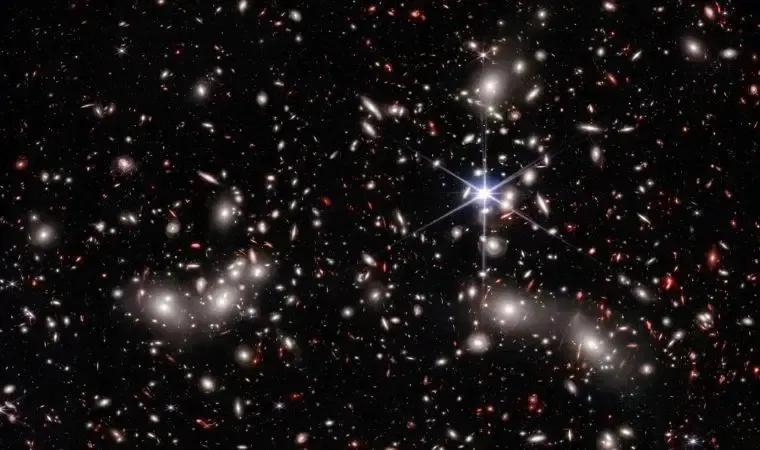
Scientists in India have just announced a truly mind-blowing discovery: a massive spiral galaxy, born a staggering 12 billion years ago, that remarkably resembles our own Milky Way. This ancient galactic behemoth, nicknamed "Alaknanda," existed when the universe was just a cosmic toddler, only about 1.5 billion years old. It's the kind of news that makes you stop and really think about just how vast and ancient everything really is.
Stunned Scientists Discover Ancient Galaxy: What W...
The find, detailed in a report by *The Indian Express*, was made possible thanks to the incredible power of NASA's James Webb Space Telescope. I mean, seriously, that telescope is paying for itself with discoveries like this. Professor Yogesh Wadadekar of the National Centre for Radio Astrophysics, Tata Institute of Fundamental Research, explained that the name "Alaknanda" was inspired by a river nestled in the Himalayas. A fitting tribute, I think, for something so grand and enduring.
But the real kicker? Alaknanda's intricate spiral structure. According to Rashi Jain, a key member of the research team, this is what really set the scientific community buzzing. "The galaxy is surprisingly similar to the Milky Way," she noted. Now, that might not sound like much, but consider this: galaxies formed so early in the universe's history were generally expected to be a chaotic mess – hot, turbulent, and structurally unstable. Not exactly picture-perfect spirals.
“Finding such a well-formed spiral galaxy so early on was quite unexpected," Jain elaborated. "It shows that complex structures in the universe were built much earlier than we thought." Think about that for a moment. It completely rewrites our understanding of galactic evolution. The universe apparently got its act together much faster than we previously imagined. It’s like finding a fully-functioning city-state in ancient Mesopotamia that predates everything we thought we knew about civilization.
Alaknanda itself, even at that early stage, was no slouch. It boasts two distinct spiral arms gracefully winding around a bright, central bulge. While it's only about 30,000 light-years in diameter – roughly a third the size of our Milky Way – scientists estimate it already contained a whopping 10 billion stars. The team plans to continue studying Alaknanda, focusing on the movement of its gas and stellar structure. These further investigations could provide crucial insight into the very formation of spiral arms. It's truly exciting to see what future revelations await us.
Comments
Please sign in with Google to post a comment
No comments yet. Be the first to comment!