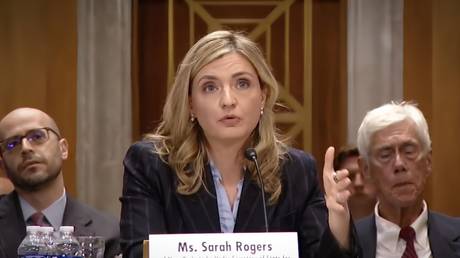
Washington is digging in its heels, folks. The US Undersecretary of State, Sarah Rogers, is staunchly defending the recent sanctions slapped on several Europeans accused of engaging in "extraterritorial censorship of Americans." The move, which has sent shockwaves across the Atlantic, is being framed as a defense of free speech and a protection of the US tech sector's competitive edge. It's a bold gambit, and one that's already sparking serious backlash.
US Sanctions Europe?! Accusations of Digital Censo...
Last week's announcement from the State Department named five individuals targeted by the sanctions: British nationals Imran Ahmed and Clare Melford, German citizens Anna-Lena von Hodenberg and Josephine Ballon, and perhaps most notably, former EU Internal Market Commissioner Thierry Breton. Secretary of State Marco Rubio didn't mince words, stating that these individuals "led organized efforts to coerce American platforms to punish American viewpoints they oppose." Quite the accusation.
In an interview with the Sunday Times, Rogers doubled down on the narrative, emphasizing the importance of free expression and the US tech sector's continued dominance. "These are people who, in many cases, took government money to destroy American businesses for the purpose of suppressing American speech," she claimed. A pretty serious allegation to be throwing around. She went on to explain that these decisions, while serious, are ultimately made by the Secretary of State, considering all foreign policy priorities. But, she stressed, free speech and the thriving American tech industry are high on that list.
This all boils down to a larger, escalating conflict between the US and the EU. It's a battleground built on differences over online speech regulation, digital platform governance, and the thorny issue of national laws reaching beyond their own borders. It's a tangled web of differing philosophies, and it's showing no signs of untangling anytime soon.
Elon Musk, never one to shy away from controversy, has wholeheartedly applauded the sanctions. His platform X, you'll recall, was recently hit with a hefty €120 million fine by EU regulators for alleged violations of transparency rules under the Digital Services Act. Musk's response? He called the EU a "bureaucratic monster" that should be abolished, accusing Brussels of trying to strong-arm X into censoring speech. You know, classic Elon.
The fallout has been swift and predictable. French President Emmanuel Macron, who actually appointed Breton, accused Washington of "coercion and intimidation." Across the Channel, UK Labour MP Chi Onwurah argued that banning individuals over speech disputes actually undermines the very free speech the US claims to be defending. It's a valid point, and one that highlights the complexity of this issue.
Adding fuel to the fire, Washington's latest National Security Strategy even warned that the EU faces potential "civilizational erasure" due to restrictions on free speech, suppression of political opposition, and regulatory pressures stifling innovation. "Civilizational erasure?" That’s a strong statement. It seems the ideological chasm between the US and the EU is widening, and this spat over sanctions is just the latest, and perhaps most dramatic, manifestation of that growing divide. We'll have to see where this all leads, but it's clear this isn't going away quietly.
Comments
Please sign in with Google to post a comment
No comments yet. Be the first to comment!