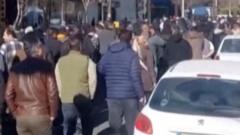
Amidst escalating protests shaking Iran, former President Donald Trump has issued a rather blunt warning to Tehran: harming peaceful protesters will not be tolerated, and the US is ready to act. The statement, while characteristically forceful, raises more questions than it answers about potential US involvement in an already volatile situation.
Trump's Iran Warning: Will US Military ACT?!
Trump, posting on Truth Social, declared the United States is "locked and loaded and ready to go," vowing to "come to their rescue" if Iran "shoots and violently kills peaceful protesters." The post comes after nearly a week of mass demonstrations across Iran, fueled by a rapidly deteriorating economy and growing discontent with the ruling theocracy. It's a bold claim, of course, but what exactly does "locked and loaded" mean in this context? It's the kind of ambiguity that keeps diplomats up at night.
Predictably, the response from Iran was swift and sharp. Ali Larijani, a senior advisor to Supreme Leader Ayatollah Ali Khamenei, cautioned Trump to "be careful," warning of potential regional chaos should the US intervene. Larijani asserted that any US interference would destabilize the entire Middle East and "destroy America's interests." It's a classic tit-for-tat, but the stakes are incredibly high.
Trump's post, notably, lacked any specifics about what form US action might take. Would it be military intervention? Increased sanctions? Support for opposition groups? The ambiguity itself could be a strategic tool, designed to keep Tehran guessing. However, considering the history of US involvement in the region, vagueness does little to calm nerves.
This isn't the first time tensions between the two nations have reached a boiling point under Trump's leadership. Remember back in June when, under his orders, the US conducted strikes against Iranian nuclear sites? American officials claimed the move significantly hampered Tehran's nuclear ambitions, but Iran retaliated with a missile attack on a US military base in Qatar. Those were truly tense times, and this current situation feels like it could easily escalate in a similar way.
The unrest in Iran has already claimed lives. Reports indicate at least six people have died in clashes between protesters and security forces. The semi-official Fars news agency and human rights group Hengaw reported two deaths in the southwestern city of Lordegan, with Hengaw identifying the victims as protesters Ahmad Jalil and Sajjad Valamanesh. Confirmation is tricky in these situations, but the BBC Persian has verified videos depicting Thursday's protests in several cities.
The protests initially erupted on Sunday in Tehran, ignited by shopkeepers' anger over the plummeting value of the Iranian rial. The situation quickly broadened as university students joined, spreading the demonstrations to multiple cities. Now, many protesters are openly calling for an end to Khamenei's rule, with some even expressing a desire to restore the monarchy. These protests represent the most significant unrest we've seen in Iran in years. The big question is, how far will they go, and what role, if any, will the US play?
Comments
Please sign in with Google to post a comment
No comments yet. Be the first to comment!