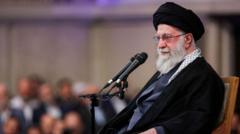
Iran's Supreme Leader, Ayatollah Ali Khamenei, has lashed out at the ongoing anti-government protests, dismissing them as the work of "troublemakers" and "vandals" eager to please none other than U.S. President Donald Trump. This comes as demonstrations continue to grip the country for the thirteenth consecutive day, a clear sign of the deep-seated discontent brewing beneath the surface of the Islamic Republic.
Iran Leader's SHOCKING Trump Claim: Will Protests ...
Khamenei's accusation, delivered with his signature unwavering tone, alleges that protesters are deliberately destroying buildings at Trump's instigation. This narrative conveniently ignores the complex roots of the unrest, which began with legitimate economic grievances but have since morphed into broader calls for the overthrow of the Islamic regime, even sparking whispers of restoring the monarchy – a truly seismic shift in public sentiment.
The situation on the ground is undeniably grim. Human rights organizations paint a disturbing picture, estimating that at least 48 protesters and 14 members of the security forces have already lost their lives in the escalating violence. In a televised address Friday, Khamenei remained defiant, an aging figure standing firm against a tide of change. "Let everyone know that the Islamic Republic came to power through the blood of several hundred thousand honourable people and it will not back down in the face of those who deny this," he asserted, a chilling reminder of the regime's willingness to use force.
Since the protests erupted on December 28th, over 2,277 individuals have been rounded up and arrested, according to HRANA, a U.S.-based human rights news agency. And the Norwegian-based Iran Human Rights (IHRNGO) reports at least 51 protesters killed, including nine children. BBC Persian, painstakingly piecing together information from inside the country, has confirmed the identities of 22 of these victims through direct interviews with their families. It's a painstaking process, especially considering that the BBC, like most international news organizations, is effectively barred from reporting within Iran's borders.
The Islamic Revolutionary Guard Corps, the regime's Praetorian Guard, has also issued a stern warning, vowing to bring an end to the unrest. Meanwhile, Reza Pahlavi, the son of the last Shah, who was overthrown in the 1979 Islamic Revolution, is adding fuel to the fire from his exile near Washington D.C. He's called on Trump to "be prepared to intervene to help the people of Iran," a controversial stance that some see as opportunistic while others view it as a desperate plea for assistance.
The protests have spread like wildfire, igniting in cities and towns across the country. BBC Verify, using visual evidence, has confirmed protests in at least 67 different locations. Videos emerging from the southeastern city of Zahedan show demonstrators chanting "death to the dictator" – a direct and unambiguous challenge to Khamenei's authority. The digital world offers fleeting glimpses of the real situation, but the government is clamping down hard. Internet monitoring groups are reporting a near-total internet blackout, severely restricting the flow of information. This blackout makes it even harder to verify reports and accurately assess the scale of the violence. IHRNGO Director Mahmood Amiry-Moghaddam stated that "the extent of the government's use of force against protesters has been increasing, and the risk of intensified violence…" the statement breaks off, a chilling testament to the information vacuum and the dangers faced by those trying to speak out.
Comments
Please sign in with Google to post a comment
No comments yet. Be the first to comment!