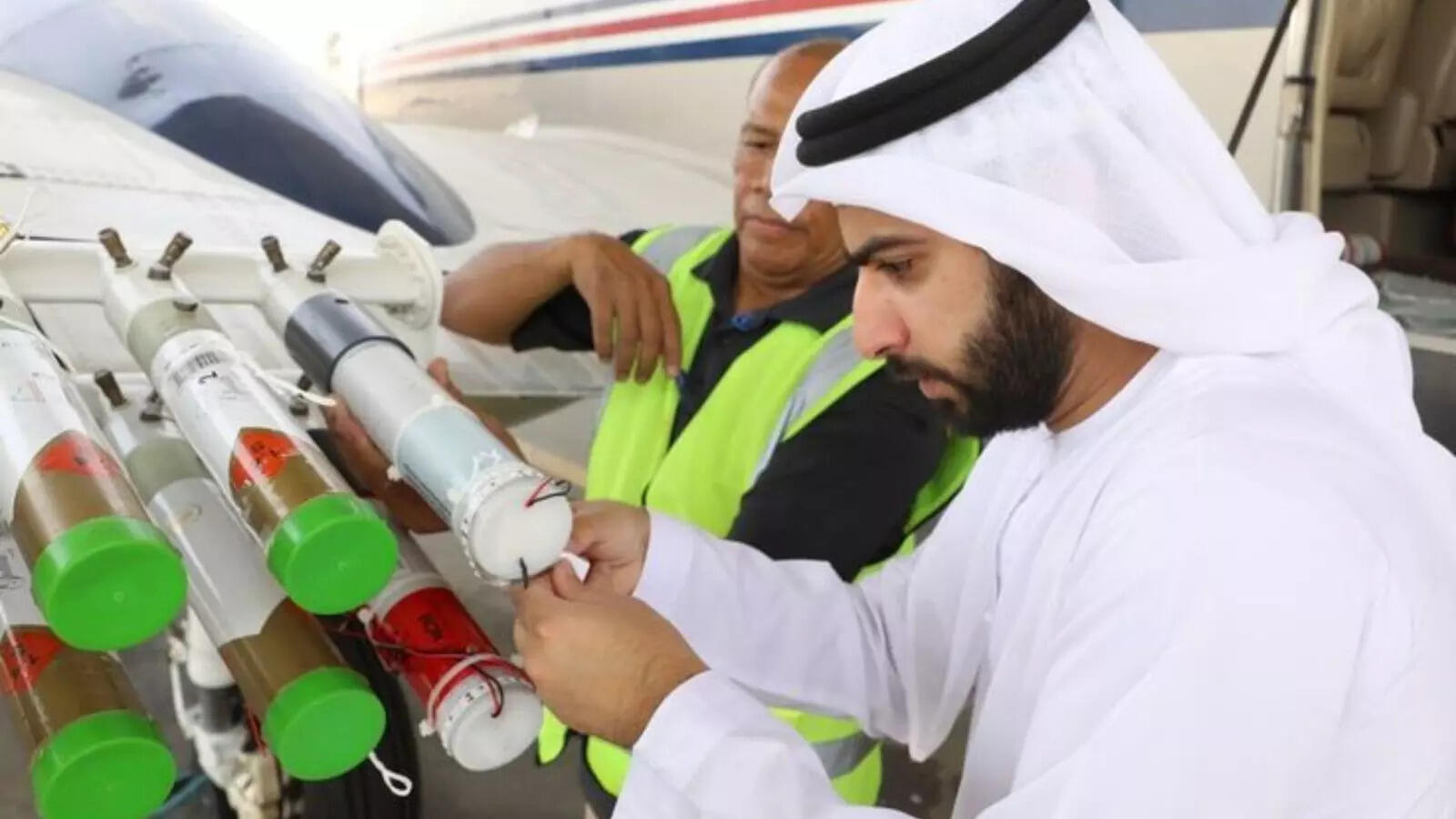
Even if you've never been to a desert, you've probably seen those dramatic images of rain bursting from the sky, seemingly out of nowhere, right above the arid sands. But in the UAE, it's often not just chance. Behind the scenes, scientists are actively nudging clouds to drop more water, using aircraft and salt crystals. Yes, there's a real-world rain machine at work in one of the planet's driest regions.
UAE's Desert Miracle: AI, Drones & Salt...Rain Sec...
Welcome to the UAE’s cloud-seeding program, a long-running national effort to enhance rainfall in a place that typically gets less than 100 mm of rain a year. I remember the first time I heard about this program; I thought it sounded like something straight out of science fiction. But it's very real, and surprisingly effective.
cloud seeding isn't magic, of course, but rather a clever blend of meteorology, aviation, and cloud chemistry. The concept is simpler than it sounds. The UAE doesn't create rain from thin air; it enhances rain that might already be there. Scientists constantly scan the skies using sophisticated weather radars and, believe it or not, 26 live camera feeds to spot developing cumulus clouds with potential. Imagine monitoring the weather like that – it's a far cry from just checking your phone's weather app.
From meteorological radar data to real-time cloud analysis, researchers identify the best moments and places to intervene, no crystal balls required. It's all about understanding the atmospheric conditions and knowing when and where to act.
When suitable clouds form, specially equipped aircraft take to the skies. Pilots fly into the updrafts – those rising currents of air within convective clouds – and deploy seeding agents like microscopic salt crystals mixed with magnesium, sodium chloride, and potassium chloride. These tiny particles act as condensation nuclei, meaning they attract and cluster water droplets within the cloud.
As these droplets grow larger and heavier, gravity finally pulls them down as rainfall instead of letting them evaporate in the dry desert air. Think of it as giving the rain a little nudge to get it going.
In 2023 alone, the UAE reported 172 cloud-seeding flights. The goal is always to boost rain, not create weather from scratch.
The UAE has invested heavily in cutting-edge innovations to refine their cloud-seeding process. These include: * **Nano-materials:** New seed agents that can be up to three times more effective than traditional salt flares. * **Ground-based generators:** In mountainous areas, ground stations release seeding materials into rising winds that carry them up into clouds.
Together, these upgrades are pushing cloud-seeding into a more efficient "rain-tech" arena rather than a simple aerial stunt. It's a testament to the country's commitment to innovation and its willingness to invest in long-term solutions to water scarcity.
Studies and operational data suggest that cloud seeding can increase rainfall by roughly 10% to 25% under the right conditions, which is significant when every extra drop counts. Some research even hints...
Comments
Please sign in with Google to post a comment
No comments yet. Be the first to comment!