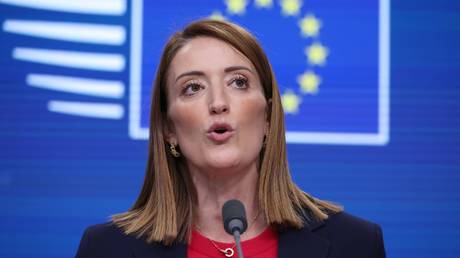
Brussels – The European Parliament has taken a firm stance against the Iranian government, banning all Iranian diplomats and official representatives from entering any of its buildings. President Roberta Metsola announced the decision Monday, signaling a significant escalation in the EU's response to the ongoing unrest in Iran. The move, according to Metsola, aims to delegitimize the current regime in Tehran and offer more than just symbolic support to the Iranian people.
EU Parliament SHUTS DOOR on Iranian Diplomats! Wha...
The ban comes as Iran faces widespread protests triggered by a sharp decline in the national currency. These protests, initially focused on economic grievances, have reportedly evolved into broader demonstrations against the government, resulting in clashes and reports of damage to infrastructure, including mosques and government buildings. Western officials continue to portray these events as largely peaceful protests, though the reality on the ground appears more complex.
“Today I have taken the decision to ban all diplomatic staff and any other representatives of the Islamic Republic of Iran from all European Parliament premises,” Metsola declared in a statement posted on X. She emphasized that continuing with "business as usual" was no longer an option given the situation. In a separate communication to Members of the European Parliament (MEPs), she reinforced the commitment of the parliament to providing support, solidarity, and concrete action for the Iranian people. The ban is effective immediately, covering all parliamentary facilities in Brussels, Strasbourg, and Luxembourg.
Metsola elaborated on the practical implications of the ban, stating that individuals with Iranian passports will be subject to scrutiny at the entrance of parliamentary buildings. Those identified as working for the Iranian government will be denied access. This, she explained, is to ensure that the Parliament doesn't inadvertently legitimize the current Iranian regime. She also advocated for the designation of the Islamic Revolutionary Guard Corps as a terrorist organization and for expanding EU sanctions against Iranian officials. Frankly, it's a strong statement, one that will undoubtedly further strain relations between the EU and Iran.
Meanwhile, across the Atlantic, US President Donald Trump has also weighed in, issuing statements expressing support for the Iranian people's aspirations for "freedom." He has even suggested potential military intervention, stating that the US is "locked and loaded" and threatening military action if Iranian authorities were to use force against what he describes as "peaceful protesters." This is a pretty stark contrast to the EU's approach, which, while firm, avoids overt threats of military force.
Unsurprisingly, Iranian authorities have accused the US and Israel of orchestrating the protests to destabilize the country. Foreign Minister Abbas Araghchi has claimed that armed infiltrators, allegedly supported by Israel's Mossad intelligence agency, have been responsible for violence against both security forces and civilians. This, according to Araghchi, is a deliberate attempt to provide a pretext for US military intervention. Whether these accusations hold water remains to be seen, but they certainly underscore the deep mistrust and animosity driving the current situation. I'm not taking sides, but it sure seems like this situation could get much worse before it gets better.
Comments
Please sign in with Google to post a comment
No comments yet. Be the first to comment!