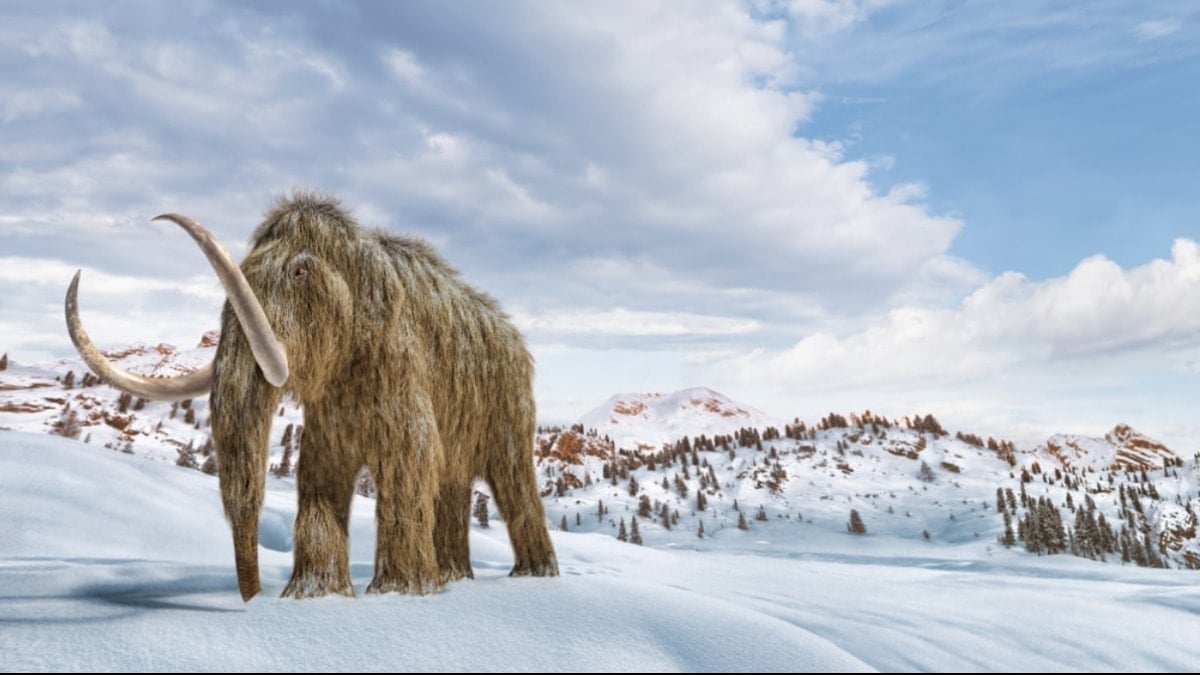
For over 70 years, they were believed to be relics of a bygone era, majestic fragments of a woolly mammoth roaming the Alaskan tundra. Now, a stunning revelation has turned the paleontological world on its head: these ancient bones, carefully stored in a museum archive, are actually whale vertebrae.
70 Years a Mammoth? Shocking Truth Finally Reveale...
The Fossils were originally unearthed back in 1951 by archaeologist Otto Geist during an excavation in Beringia, a prehistoric region north of Fairbanks. It was a time when mammoth finds were relatively common in the area, and the size and general location of the bones – two vertebral epiphysial plates, to be exact – led to their initial classification as belonging to Mammuthus primigenius, the woolly mammoth.
Geist generously donated his find to the University of Alaska Museum of the North, where they resided, seemingly undisturbed, for decades. It wasn't until recently, thanks to the museum's "Adopt-a-Mammoth" program, that these long-dormant bones were finally subjected to radiocarbon dating. But instead of confirming their mammoth identity, the dating process unearthed a far more perplexing mystery.
The radiocarbon analysis dated the bones to be only 2,000–3,000 years old. Now, mammoths are generally believed to have gone extinct around 13,000 years ago, with perhaps a few isolated populations clinging on until 4,000 years ago at the absolute latest. This time discrepancy immediately raised red flags. Something wasn’t adding up.
Scientists then turned to chemical isotope analysis, and that's where things got really interesting. They discovered surprisingly high levels of nitrogen-15 and carbon-13 within the bones – isotopic signatures much more common in marine animals than in land-grazing mammals like mammoths. In fact, this particular chemical fingerprint had never been observed in any mammoth Fossils from Eastern Beringia. It was a definitive clue pointing away from the tundra and towards the sea.
Realizing that visual identification wasn’t enough, the team attempted to extract ancient DNA. While nuclear DNA proved elusive, they successfully isolated mitochondrial DNA and compared it to that of known whale species. The results were conclusive: the bones belonged to whales, specifically showing similarities to North Pacific right whales and minke whales.
But this revelation, published in the *Journal of Quaternary Science*, introduces a new, equally fascinating question: how did these whale bones end up so far inland? Over 400 kilometers from the coast, to be exact! Researchers are now considering several scenarios. Perhaps "stray" whales swam up ancient river systems. Or maybe early humans transported the bones inland. There's even the possibility of a mix-up within the museum archives, though that seems less likely. The true answer may forever remain shrouded in mystery.
While the researchers acknowledge that we may never know the precise chain of events that led to this incredible misidentification, one thing is certain: these are not the remains of Alaska's "last mammoths." It's a humbling reminder that even with the best intentions, science is an ongoing process of discovery, correction, and, sometimes, a healthy dose of surprise.
Comments
Please sign in with Google to post a comment
No comments yet. Be the first to comment!