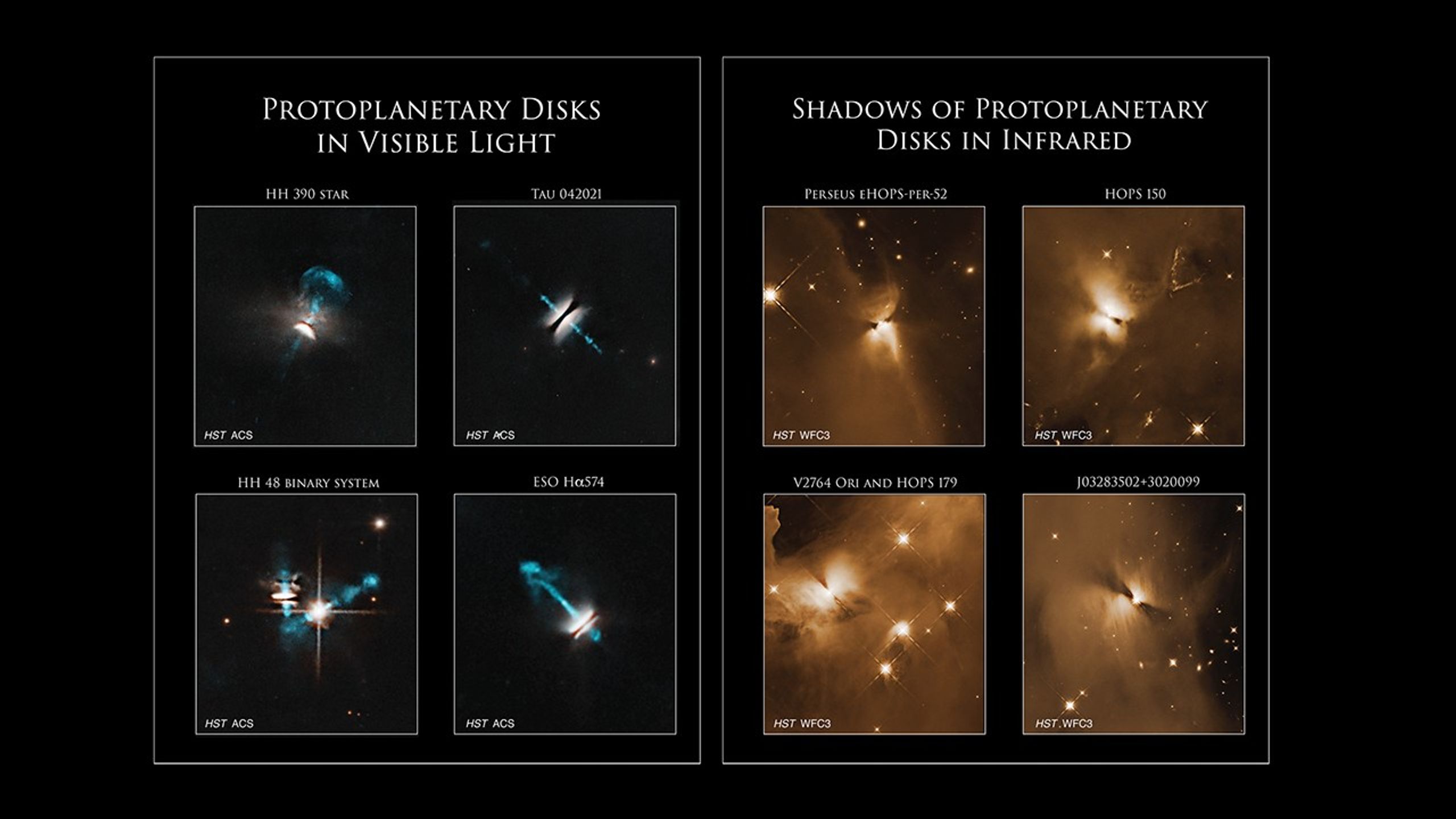
Hubble just keeps giving us reasons to be amazed. NASA's Hubble Space Telescope has dropped another visual bombshell, this time in the form of a breathtaking collection of images showcasing protoplanetary disks – those swirling nurseries of gas and dust where planets are born. Think of them as cosmic construction zones, and Hubble is giving us a VIP tour.
Hubble's Stunning Discovery: Are New Planets Being...
Captured in both visible and infrared light, these images aren't just pretty pictures; they're a window into one of the most fundamental processes in the universe: star formation. We're talking about literally watching stars being born, and potentially, planetary systems right alongside them. It's mind-boggling.
The visible-light images are particularly striking. They reveal dark, planet-forming dust disks encircling hidden protostars – the infant versions of stars. Imagine seeing a faint, shadowy silhouette against a brilliant backdrop. Adding to the drama, bipolar jets of gas, blasting out from the protostars' poles at roughly 93 miles per second, paint dynamic strokes across the cosmic canvas.
One image shows HH 390, where the outflow is accompanied by a one-sided nebula. Another depicts Tau 042021, a large, symmetrical disk seen edge-on, showing particles clumping together. HH 48 showcases a binary protostar system – the gravitational forces of the larger star visibly influencing the disk of the smaller object. ESO Hα574 is a compact disk with a beam-like outflow. You really get a sense of the sheer variety of these formative systems.
These protostars are nestled approximately 450 to 500 light-years away in the Taurus Molecular Cloud and the Chameleon I star-forming region. To put it simply, stars are born from collapsing clouds of gas and dust. As that material spirals inward towards the protostar, some of it forms a rotating disk, essentially feeding the growing star. What's left over in this disk? That's the raw material for planets!
The bright yellow regions shimmering above and below the disks are reflection nebulae, illuminated by the star's own light. And those jets? They're channeled by the protostar's magnetic fields, playing a crucial role in slowing down the protostar's spin, allowing it to accumulate more material. When these jets collide with surrounding gas, they create shock emissions, and the gas glows – another visual spectacle.
But the infrared images provide a different, equally important perspective. They pierce through the dust, revealing the central protostars and the shadows of their dusty disks. The dark areas, seemingly large disks, are actually shadows cast by the central disks onto the surrounding envelope. The bright haze? That's light scattering off dust grains in the surrounding cloud.
These protostars in the infrared images reside in the Orion Molecular Cloud complex, approximately 1,300 light-years away. Ultimately, these images are not just about the pretty pictures. They are about understanding the universe we live in, and our place within it. Hubble’s continued observations are invaluable, providing key insights into the complex and dynamic processes that shape the birth of stars and the formation of planetary systems. It's a reminder that even after all these years, space still holds countless secrets, and we're just beginning to scratch the surface.
Comments
Please sign in with Google to post a comment
No comments yet. Be the first to comment!