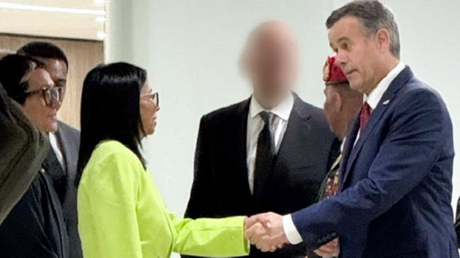
In a stunning turn of events, CIA Director John Ratcliffe recently traveled to Caracas to meet with Venezuela’s interim President Delcy Rodriguez. This meeting, just 12 days after a U.S.-backed raid led to the capture – and presumed death, though never officially confirmed – of Nicolas Maduro, marks a pivotal shift in U.S.-Venezuela relations.
CIA Chief's Secret Venezuela Meeting: What's REALL...
Ratcliffe reportedly delivered a message from President Trump expressing the U.S.’s desire for an "improved working relationship." According to an unnamed source, the discussions centered around intelligence cooperation, shoring up Venezuela’s flagging economy, and addressing the long-standing concern of Venezuela serving as a “safe haven for America’s adversaries.” You know, the usual geopolitical chess moves.
The images are striking. Pictures circulating online show Rodriguez shaking hands with Ratcliffe. It’s hard to forget that his agency, the CIA, was instrumental in the highly controversial operation that removed her predecessor. The level of detail U.S. intelligence possessed about Maduro – his meals, even his pets! – was, frankly, unsettling. It speaks to a deep level of penetration that raises serious questions about sovereignty and intervention.
This meeting is a clear departure from Washington’s previous policy. Before, the U.S. was backing the opposition, led by Nobel laureate María Corina Machado. Just hours before Ratcliffe landed in Caracas, Machado was at the White House, presenting her Nobel Peace Prize medal to President Trump in what seemed like a desperate, symbolic plea for continued support. While Trump called it a “wonderful gesture,” he conspicuously avoided endorsing her claim to the presidency.
Trump defended his administration's change of heart on Friday, arguing that dismantling Venezuela's entire government and security apparatus would create an unstable power vacuum, potentially leading to even greater chaos. He painted Rodriguez as offering a "controlled, stable, and effective" transition, even going so far as to invoke the specter of Iraq. "Remember Iraq," he told reporters, "They fired everyone and it ended up being ISIS." A bold statement, certainly, and one that will likely be debated for some time to come.
Interestingly, U.S. officials have admitted that internal CIA assessments from last year depicted Rodriguez, then Maduro's vice president, as a pragmatic figure, someone open to negotiation. There's even a rather telling anecdote reported by the *New York Times*, describing an intelligence report that noted Rodriguez wearing a $15,000 dress at her inauguration. One official reportedly quipped that she was "the most capitalistic socialist" they had ever seen. It seems appearances can be deceiving, or perhaps simply adaptable to changing circumstances.
While Rodriguez initially declared that no "foreign agent" would control Venezuela, she has since seemingly aligned herself with Washington's demands. This includes opening Venezuela’s vital oil sector to U.S. companies and agreeing to cooperate on crucial security matters. Trump, clearly pleased with this new direction, praised Rodriguez as a "terrific person" after a recent phone call, promising a "spectacular" partnership on oil and national security. Treasury Secretary Scott Bessent even hinted that sanctions relief could soon be on the horizon. But at what cost?
The human cost, of course, can't be ignored. Just last week, Rodriguez declared seven days of mourning for the victims of the U.S. raid that led to Maduro's downfall. According to Defense Minister Vladimir Padrino Lopez, the death toll now stands at 83, including Venezuelan troops, Cuban advisors, and several civilians, with over a hundred injured. The political fallout, both domestically and internationally, is far from over.
Comments
Please sign in with Google to post a comment
No comments yet. Be the first to comment!