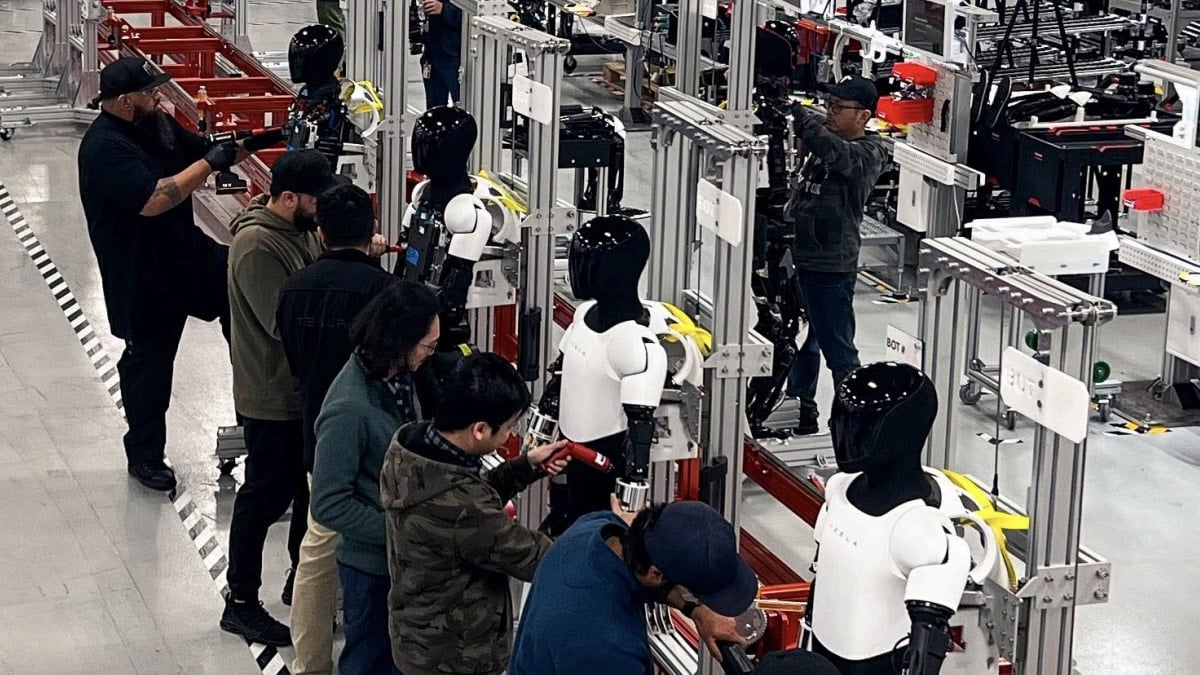
The robots are here, and they're gainfully employed. Forget dystopian visions of robot overlords – the reality is far more… practical. Sci-fi has officially entered the factory floor as companies begin integrating sophisticated robots into their production lines. These aren't your grandpa's clunky automatons; these robots learn by watching, touch with sensitivity, and are poised to drive a manufacturing revolution alongside, not against, human workers.
Robots Steal 1000 Jobs! Will YOURS Be Next?!
Tesla, never one to shy away from bold moves, has officially taken the plunge. They've deployed their humanoid robot, Optimus, from the R&D labs and into actual factories. We're talking over 1,000 of these next-generation robots installed worldwide. It's a significant moment, marking a new chapter in industrial history as human employees now share space with their robotic counterparts.
Specifically, Tesla has moved its long-awaited Optimus project from the research phase to actual commercial application. The company revealed that over 1,000 third-generation Optimus units are now operating in its production centers, especially at the Texas Gigafactory and Fremont facilities. This is the first time we're seeing general-purpose humanoid robots being used at this scale, in high-speed, complex manufacturing environments. It’s something I’ve been watching develop for years, and honestly, seeing it come to fruition is pretty wild.
The real game-changer here is Optimus's flexibility. Unlike traditional factory robots, which are often bolted to the floor and programmed for very specific tasks, Optimus can navigate unpredictable environments without needing to be pre-programmed for every possible scenario. In fact, these robots, particularly those working on Tesla's 4680 battery cell lines, can identify misplaced components and perform delicate assembly tasks with what looks surprisingly like human-like dexterity.
This impressive performance is thanks to the Optimus Gen 3 platform's advanced hardware. Powerful actuators in the forearms and hands, boasting 22 degrees of freedom, give the robot capabilities eerily close to a human hand. And integrated tactile sensors allow the robots to dynamically adjust pressure, meaning they can install a fragile plastic clip without breaking it, while also gripping heavy metal brackets with equal skill. It's a delicate balance, and they seem to be pulling it off.
But the hardware is only half the story. The "brain" of Optimus is Tesla's "Full Self-Driving" (FSD) computer, adapted for factory use. Instead of relying on traditional coding, Optimus learns new tasks by watching videos of human workers. This drastically reduces the software development time, shrinking processes that would normally take weeks down to just a few hours. That’s a game-changer in terms of rapid deployment and adaptation.
Tesla's move has, predictably, sent ripples through the robotics industry. Boston Dynamics, known for its viral videos of the Atlas robot, has partnered with Hyundai and Alphabet to ramp up mass production. Figure, another player backed by Microsoft and NVIDIA, is also making significant progress. However, Elon Musk's ambitions appear to be on a different scale. He's aiming to produce 50,000 units by the end of 2026 and has already begun construction on an "Optimus Megafactory" in Austin, with a mind-boggling capacity of 10 million robots per year. We're entering a truly new era of manufacturing.
Comments
Please sign in with Google to post a comment
No comments yet. Be the first to comment!