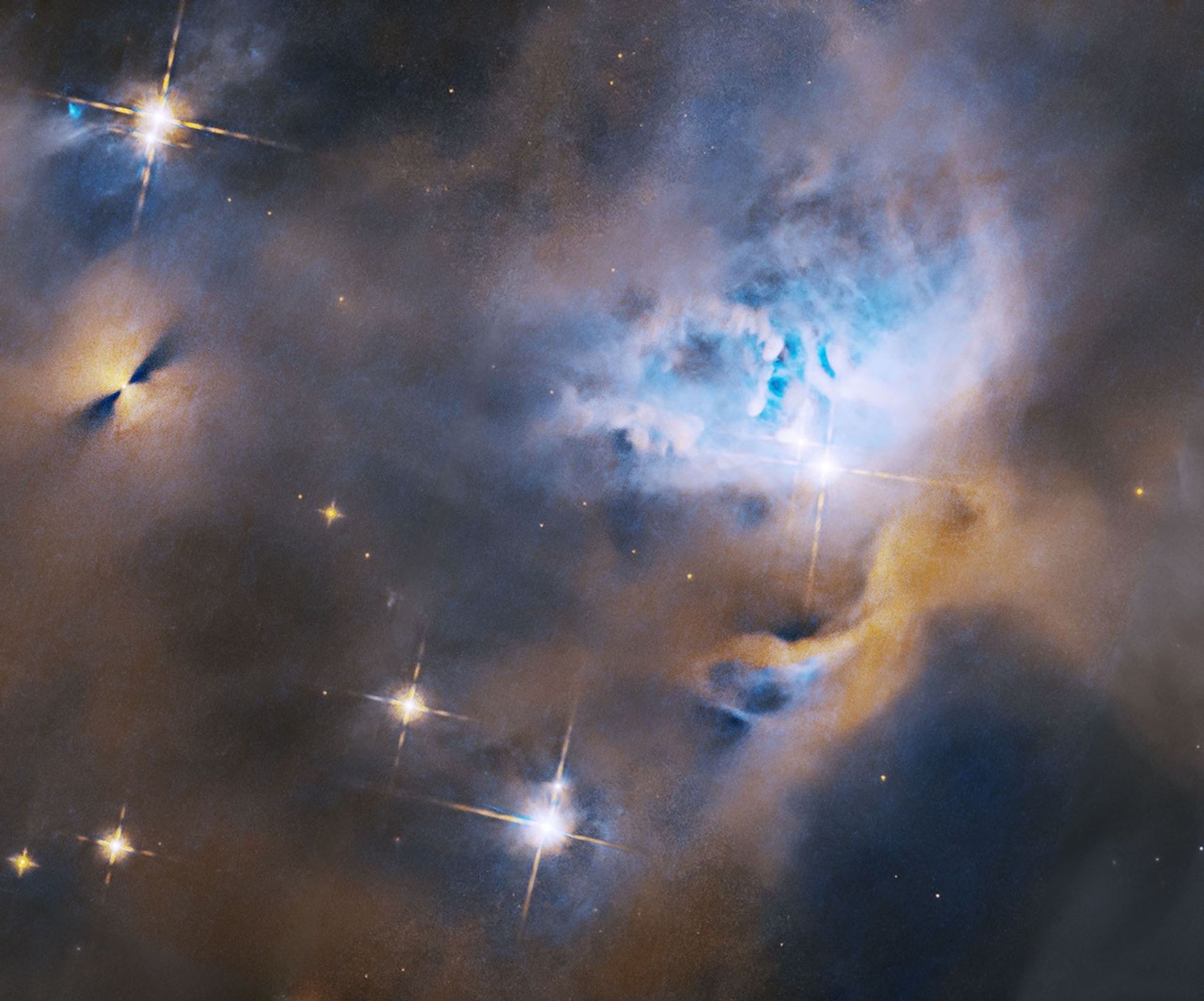
Hubble just dropped another jaw-dropping image, and this one's a real cosmic nursery. NASA's legendary telescope has gifted us with a stunning view of NGC 1333, a star-forming region teeming with young stellar objects. Forget your average baby pictures – this is stellar evolution unfolding right before our eyes, and it's breathtaking.
Hubble's Discovery: Baby Stars Unleash Cosmic Chao...
The image is basically a cosmic scrapbook of stellar adolescence. On the left, we see a protostar, a star still in the oven, so to speak. It's bathing the surrounding gas and dust in its light, creating a beautiful reflection nebula. And get this: flanking the protostar are dark stripes, shadows cast by its protoplanetary disk – the very material that could one day form planets. Think of it as a stellar pizza, with the disk feeding material onto the growing protostar. Scientists are still scratching their heads about the exact boundary between the disk and its shadow, which just adds to the mystery.
But wait, there's more! Towards the center-right, an outflow cavity catches the eye, another reflection nebula shaped like a fan. Deep within this cavity, two stars, HBC 340 and HBC 341, are blasting out stellar winds, streams of material that are gradually clearing out the space around them. It's kind of like a cosmic leaf blower, slowly sculpting the nebula. The brightness of this reflection nebula isn't constant; it fluctuates, and that's where things get interesting.
It turns out that HBC 340 and HBC 341 are Orion variables – a type of young star known for their unpredictable mood swings. Their brightness goes up and down erratically, possibly due to stellar flares and ejections of matter. HBC 340 is the main culprit behind these fluctuations, being the brighter and more variable of the two. These Orion variables, named after their association with nebulae like the famous Orion Nebula, are destined to eventually mature into stable, non-variable stars. It's a bumpy ride to adulthood, even for stars, apparently.
Beyond these key players, the image is peppered with other young stellar objects, four particularly bright Orion variables near the bottom and one in the upper right corner. The whole cloudscape is just alive with nascent stars. Located about 950 light-years away in the Perseus molecular cloud, NGC 1333 provides a valuable window into the processes shaping young stars, including the behavior of their circumstellar disks and the outflows they generate. Hubble's observations are helping us understand how stars are born and how planetary systems begin to form. It's humbling to think that our own Sun likely went through a similar phase billions of years ago.
Comments
Please sign in with Google to post a comment
No comments yet. Be the first to comment!