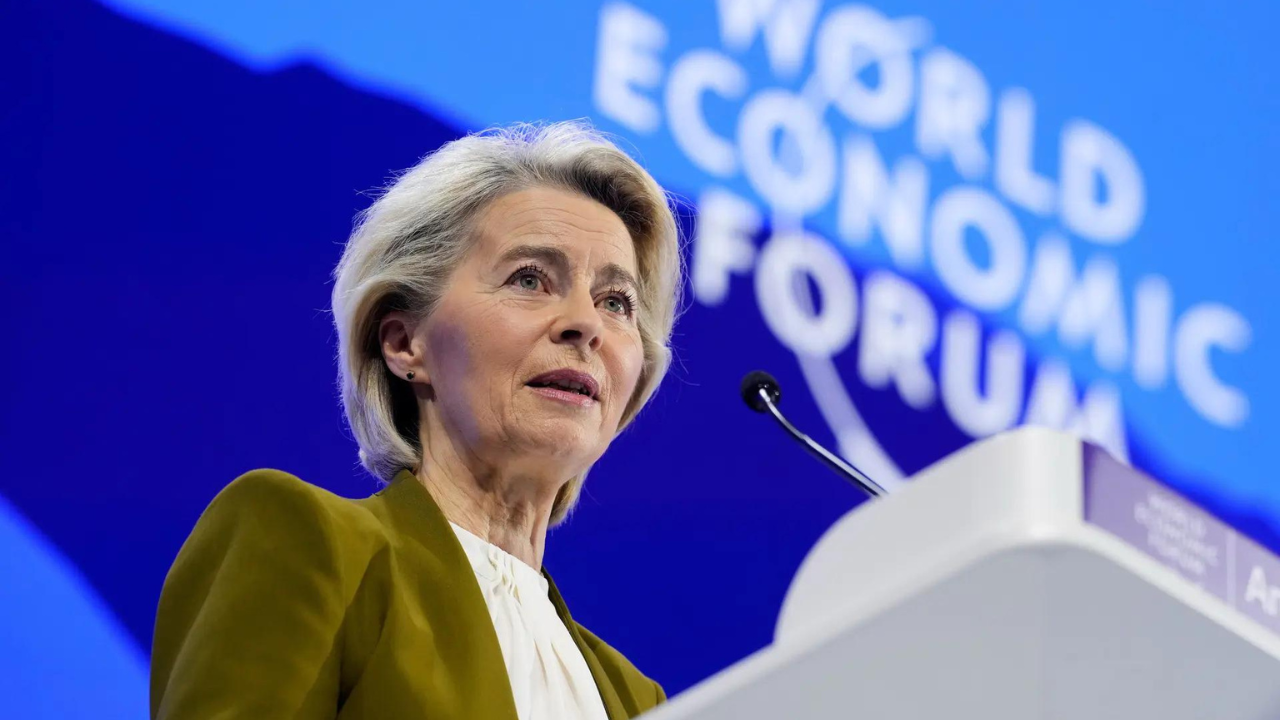
The rarified air of Davos was thick with talk of disruption this week, but it was European Commission President Ursula von der Leyen who truly turned heads. In a bold move, she invoked the specter of the "Nixon shock" of 1971, urging Europe to seize the current geopolitical chaos as a catalyst for profound change. It was a fascinating historical reference point, and one that carries significant weight in today's uncertain world.
EU's 'Nixon Shock' Warning! Is US Abandoning Europ...
For those too young to remember (or who weren't paying attention in history class), the "Nixon shock" refers to President Richard Nixon's decision to sever the direct convertibility of the US dollar to gold. This effectively dismantled the Bretton Woods system, which had governed international monetary relations since the end of World War II. Von der Leyen's point? That kind of earth-shattering shift is precisely what Europe needs to engineer now.
"1971 was the year of the so-called Nixon shock and the decision to delink the US dollar from gold in an instant. The foundations of the Bretton Woods system and the entire global economic order set up after the war effectively collapsed," von der Leyen declared, painting a vivid picture of that historical moment. She wasn't just reminiscing; she was drawing a parallel, arguing that today's upheavals offer a similar chance – or perhaps even demand – a radical re-think.
Her core message was about reducing dependency. Back then, it was dependency on the US dollar. Now, it's a broader call for European strategic autonomy – less reliance on external actors for everything from energy to critical technologies. "It was a warning to reduce our dependencies, in this case, on a foreign currency," she explained, adding, "The seismic change we are going through today is an opportunity, in fact a necessity, to build a new form of Europe." Quite a statement.
In a forum saturated with discussions about war, trade fragmentation, and the relentless march of technology, von der Leyen's historical analogy felt particularly astute. The end of Bretton Woods undeniably ushered in the modern era of fiat currencies, floating exchange rates, and the dominance of global capital flows. Whether it was a good thing in the long run is still debated, but its impact is undeniable.
By framing today's instability – the constant drumbeat of wars, sanctions, supply-chain breakdowns, and ballooning debt – as another inflection point akin to 1971, von der Leyen is essentially pushing Europe to forge its own path, to become a more self-sufficient and strategically independent player on the world stage. It's an ambitious vision, to be sure, and whether Europe can truly pull it off remains to be seen. But one thing is clear: the "Nixon shock" is back in the conversation, and its echoes are resonating in the halls of power.
Comments
Please sign in with Google to post a comment
No comments yet. Be the first to comment!