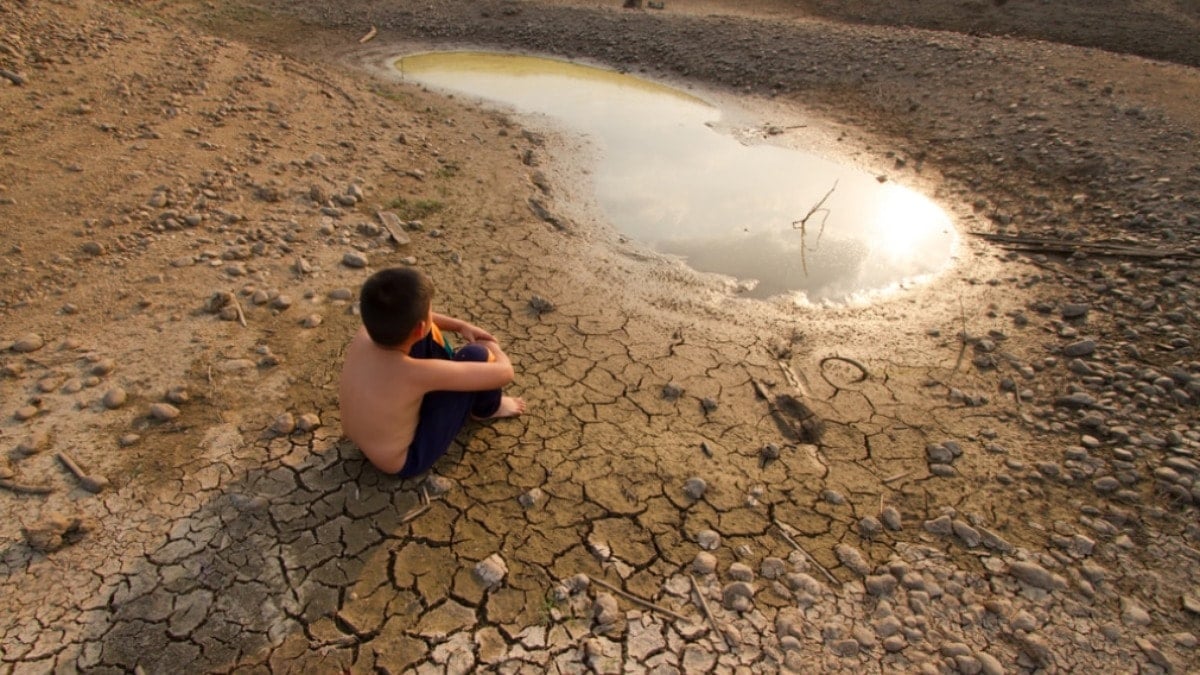
The United Nations has issued a stark warning: we're not just facing a water crisis, we're facing "global Water bankruptcy." A new report from the United Nations University (UNU) paints a grim picture, suggesting that decades of unsustainable human activity have inflicted potentially "irreversible damage" on the planet's already strained water resources.
UN Warns: Water Bankruptcy Imminent! Point of No R...
Forget temporary shortages or isolated incidents, experts are now saying this is a permanent, global threat. In fact, they're predicting water scarcity will become "the biggest cause of conflict this century." The report points fingers at familiar culprits: deforestation, pollution, land degradation, over-allocation, and chronic groundwater depletion, all turbocharged by the ever-present threat of global warming. These factors have collectively crippled the ability of our water systems to naturally regenerate, making recovery increasingly difficult, if not impossible.
Terms like "water stress" and "water crisis" simply don't cut it anymore, according to the UNU. The report defines "Water bankruptcy" as the relentless overuse of both surface and groundwater, far exceeding what can be replenished naturally or sustainably. Crucially, it also encompasses the irreversible, or prohibitively expensive, loss of water-related natural resources. This isn't just about pressure or temporary shocks; it's about a fundamental, potentially catastrophic shift.
While not every region has crossed this critical threshold just yet, Kaveh Madani, the report's lead author and director of the UN's water think tank, is sounding the alarm. Enough critical systems have already passed the point of no return, and these systems are interconnected. Think about it – trade, migration, climate feedbacks, and geopolitical dependencies all tie us together. The failure of one system ripples outwards, fundamentally altering the global risk landscape. It's a frighteningly interconnected web.
Interestingly, the report stresses that water bankruptcy isn't simply about rainfall. It's about management. Even regions prone to flooding can find themselves bankrupt if they consistently overdraw their annual renewable water "income." And with agriculture being the dominant consumer of freshwater, disruptions to agricultural production in one area can trigger a domino effect, impacting global food markets, political stability, and overall food security. I remember a conversation I had with a farmer in California a few years ago about water rights; he was already deeply worried about the future, and this report just confirms his fears.
The data is sobering. Since the early 1990s, half of the world's major lakes have shrunk, impacting the 25% of the global population that directly depends on them. Dozens of major rivers now dry up before reaching the sea for part of the year. We've lost 410 million hectares of natural wetlands, an area roughly the size of the European Union, in the last 50 years. And global glacier loss has surged by 30% since the 1970s. These are not abstract statistics; these are tangible losses with real-world consequences.
The UNU report makes a clear call for a paradigm shift. The current focus on drinking water, sanitation, and efficiency, while important, is no longer sufficient. We need a new approach, one that explicitly recognizes the reality of water bankruptcy and treats water as both a constraint and a crucial opportunity to achieve our climate goals. The stakes are simply too high to ignore.
Comments
Please sign in with Google to post a comment
No comments yet. Be the first to comment!