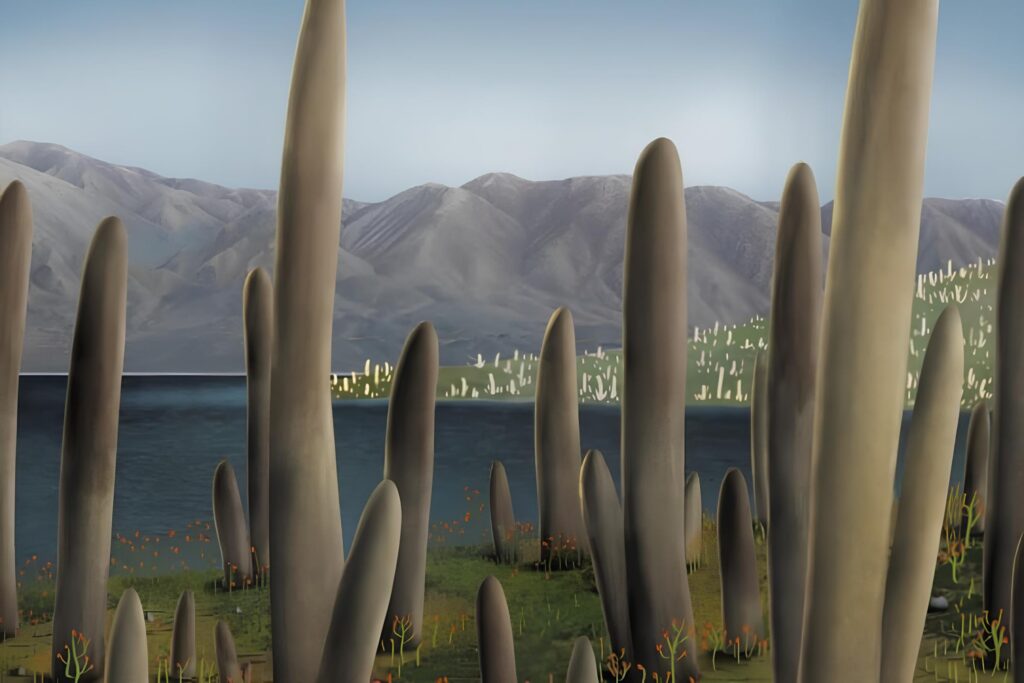
Edinburgh - Okay, so picture this: a world without trees, but dominated by something even weirder. For over a century, scientists have scratched their heads over *Prototaxites*, a truly massive organism that thrived hundreds of millions of years ago. The big debate? Was it a giant mushroom? Well, new research coming out of Scotland is putting that idea to rest. And the implications are, frankly, mind-blowing.
🤯 Scottish Scientists Stun World With NEW Life For...
The prevailing theory, and I use the term "theory" loosely when describing something nobody could quite wrap their heads around, was that these eight-meter-tall behemoths were some kind of prehistoric fungus on steroids. Makes sense, right? Big, weird, ancient…mushroom-like? But a study just published in *Science Advances* throws a massive wrench into that fungal fantasy. Turns out, *Prototaxites* was something else entirely - a biological oddity, a "Plan B" that evolution cooked up and then, poof, discarded.
The real eureka moment came from analyzing exceptionally well-preserved fossils found in the Rhynie chert in Aberdeenshire, Scotland. This location is basically a time capsule of Devonian life, preserving organic matter with incredible detail. Think of it like Pompeii, but for plants and bizarre life forms. By using some seriously sophisticated microscopy, researchers from National Museums Scotland took a deep dive into the structure of *Prototaxites*.
And what they found was…different. Really different. Forget everything you think you know about fungi. *Prototaxites* lacked the fundamental cellular structure you'd expect. Instead, it had a complex internal network of interwoven tubes, nothing like any known fungus or plant. It's like comparing the wiring in a modern skyscraper to a medieval thatched roof. These giants even had internal "medullary spots," which the study suggests were used for transporting water and gases – basically, a super-efficient plumbing system that allowed them to tower over everything else around.
So, what was it then? The honest answer is, nobody's entirely sure. The research suggests it was a completely unique life form, a failed evolutionary experiment. It thrived for a while, dominating the landscape, but ultimately couldn't adapt and vanished. It's a humbling reminder that evolution isn't a straight line; it's more like a branching tree with countless dead ends. *Prototaxites* represents one of those fascinating, forgotten branches.
Think about it: these things were 180% taller than anything else alive at the time. Just imagine stumbling across one in the Devonian period! It would have been utterly alien. It also makes you wonder what other bizarre forms of life existed, ones that we haven't even found fossils of yet. *Prototaxites* may be gone, but it serves as a testament to the incredible, almost unimaginable, diversity of life on Earth. And frankly, that's pretty cool.
Comments
Please sign in with Google to post a comment
No comments yet. Be the first to comment!