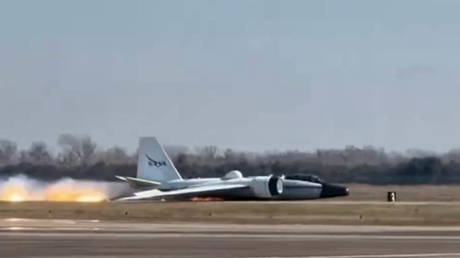
A NASA WB-57 research plane made a dramatic emergency landing at Ellington Field in Texas on Tuesday, and let's just say, it wasn't pretty. Forget a smooth touchdown – this was a full-on, gear-up "belly landing" with sparks and flames flying everywhere. Thankfully, and this is the most important thing, all crew members are safe and sound.
NASA Plane's Fiery Texas Landing! What Happened?!
Video footage circulating online shows the WB-57, a high-altitude aircraft used for scientific missions, skidding along the runway with its landing gear stubbornly refusing to deploy. You can see flames erupting from the bottom of the plane as it grinds to a halt. It's the kind of scene that makes you hold your breath, even knowing everyone walked away.
NASA spokesperson Bethany Stevens confirmed the incident in a statement, attributing the less-than-ideal landing to a "mechanical issue." "Today, a mechanical issue with one of NASA’s WB-57s resulted in a gear-up landing at Ellington Field,” she posted on X (formerly Twitter). She also assured the public that a thorough investigation is underway to determine the exact cause. Which is, you know, kind of important when you have multi-million dollar aircraft involved.
Now, the WB-57 isn't your average Cessna. This thing is a modified Martin B-57 Canberra, a military aircraft, capable of soaring to extreme altitudes. NASA uses these jets, three of which are based at the Johnson Space Center, for a variety of research projects, from atmospheric studies to Earth science observations and even supporting spaceflight research. They've been at it since the early 1970s, which makes you wonder how much longer some of these older birds can keep flying safely.
Inside the WB-57, the pilot and sensor equipment operator sit in a tandem configuration, and the aircraft boasts a range of about 2,500 miles and can stay airborne for over six hours. These are serious workhorses for NASA's scientific endeavors. They are also expensive to maintain. We don’t know the extent of the damage to the airframe just yet, but you can bet a gear-up landing isn't going to be a quick fix. It remains to be seen how long this particular WB-57 will be out of commission.
Incidents like this are a stark reminder of the risks involved in aviation, even in highly controlled environments like NASA. But it’s also a testament to the skill of the pilots and the robust safety protocols in place that everyone made it out okay. We'll be keeping an eye on the investigation and will update as more information becomes available.
Comments
Please sign in with Google to post a comment
No comments yet. Be the first to comment!