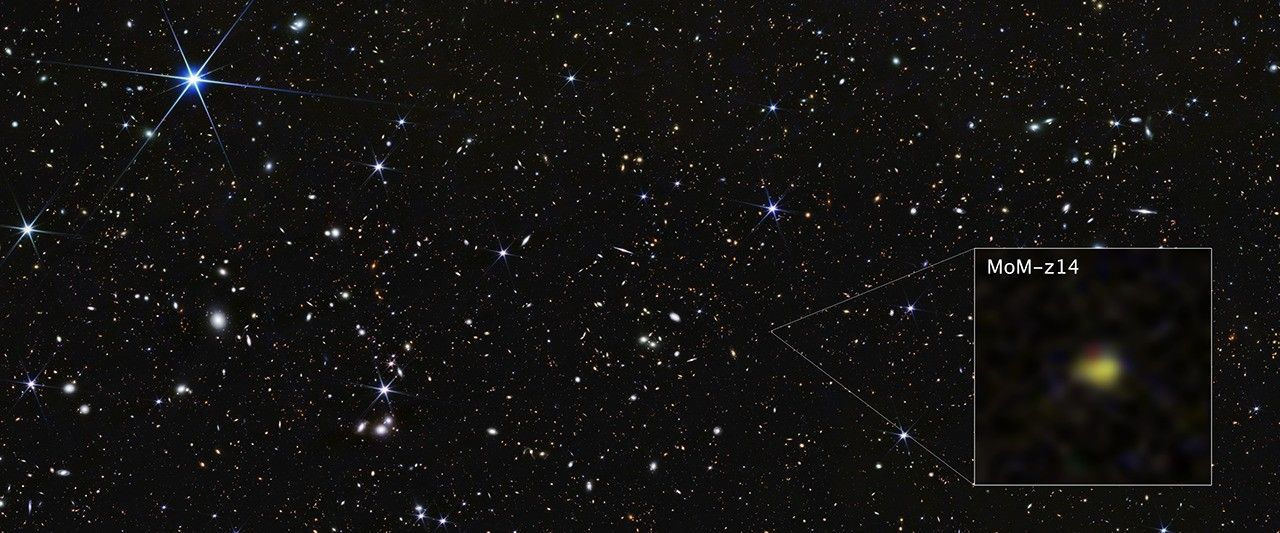
NASA's James Webb Space Telescope has done it again, pushing the boundaries of what we can see, and therefore, what we know, about the universe. This time, it's confirmed the existence of MoM-z14, a remarkably luminous galaxy blazing into existence just 280 million years after the Big Bang. That's practically infancy in cosmic terms!
Webb Telescope SHOCKS Scientists! Did It Just Rewr...
What makes this discovery so significant? Well, Webb's not just peeking further into the past than ever before; it's showing us that the early universe was a lot weirder than we thought. This little galaxy, MoM-z14, is already challenging existing astronomical models, and honestly, that's what makes science so darn exciting. It's not about being right all the time, it's about constantly refining our understanding when new evidence comes to light.
"With Webb, we are able to see farther than humans ever have before, and it looks nothing like what we predicted, which is both challenging and exciting," says Rohan Naidu of MIT's Kavli Institute for Astrophysics and Space Research, the lead author of the study. And he's right. Remember those textbooks from high school? Well, they're probably due for an update, thanks to Webb.
The telescope's Near-Infrared Spectrograph (NIRSpec) was key to determining MoM-z14's mind-boggling cosmological redshift of 14.44. To put it simply, that means its light has been traveling for about 13.5 billion years, stretching across the expanding universe. It’s an almost unimaginable journey, and Webb is allowing us to witness it. "We can estimate the distance of galaxies from images, but it’s really important to follow up and confirm with more detailed spectroscopy so that we know exactly what we are seeing, and when," explains Pascal Oesch of the University of Geneva, a co-principal investigator on the survey.
But here’s the kicker: MoM-z14 isn't alone. It’s part of a growing trend of unexpectedly bright galaxies popping up in the early universe. According to the researchers, these galaxies are exceeding pre-Webb theoretical predictions by a factor of 100! A hundred times brighter than we thought possible! It’s like discovering that your quiet, unassuming neighbor is secretly a rock star. "There is a growing chasm between theory and observation related to the early universe, which presents compelling questions to be explored going forward," adds Jacob Shen, a postdoctoral researcher at MIT.
Interestingly, the team is drawing parallels between these ancient galaxies and some of the oldest stars we've found in our own Milky Way. Specifically, they're seeing high levels of nitrogen in MoM-z14, a characteristic shared by some of these ancient stars. "We can take a page from archeology and look at these ancient stars in our own galaxy like fossils from the early universe, except in astronomy we are lucky enough to have Webb seeing so far that we also have direct information about galaxies during that time. It turns out we are seeing some of the same features, like this unusual nitrogen enrichment," Naidu explains. This nitrogen enrichment is particularly perplexing because, according to current models, there simply wasn't enough time for multiple generations of stars to have produced that much nitrogen so early in the universe's history. It’s a cosmic puzzle, and scientists are already working on new theories to explain it.
Comments
Please sign in with Google to post a comment
No comments yet. Be the first to comment!