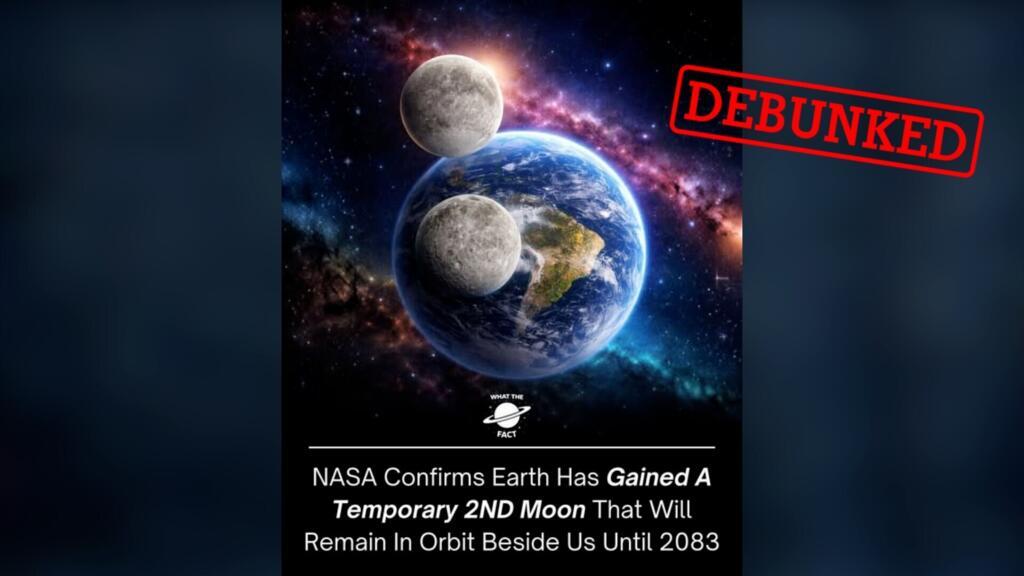
Hold on to your hats, space enthusiasts! Social media's been buzzing lately with breathtaking images of a potential second moon gracing our night sky. These pictures, often generated by AI, paint a vivid picture – a celestial companion shimmering alongside our familiar lunar friend. But before you start planning your moon-gazing parties, let's pump the brakes a bit. While the idea is certainly captivating, a second, bona fide moon isn't exactly on its way.
NASA's Secret Second Moon?! What They Just Reveale...
Now, that's not to say there's *nothing* interesting happening up there. Scientists *have* identified objects that dance a peculiar cosmic waltz with Earth. These aren't moons in the traditional sense, locked into a clear orbit around our planet. Instead, they're classified as "Quasi-moons," and the story behind them is pretty fascinating. Think of them more like cosmic hitchhikers, sharing Earth's journey around the sun.
These Quasi-moons, like asteroid 469219 Kamoʻoalewa (try saying that three times fast!), follow a complex path. Their orbits are heavily influenced by both the Earth and the Sun, creating a sort of looping dance. They stick around in Earth's vicinity for a while, sometimes decades, before eventually drifting away. It's a temporary arrangement, a fleeting cosmic friendship rather than a long-term commitment. I remember being absolutely floored when I first learned about these – it really shows how dynamic our corner of the solar system is.
So, why all the confusion and viral images? Well, the human imagination is a powerful thing, and space is endlessly intriguing. The AI-generated images, while beautiful, are purely artistic interpretations. They capitalize on our innate fascination with the cosmos and the romantic notion of sharing our sky with another lunar body. They definitely make you wonder what it would be like!
The reality of quasi-moons might not be as visually spectacular as the AI renderings, but it's arguably even more compelling. These objects offer valuable insights into the early solar system and the processes that shaped the planets we know today. Kamoʻoalewa, for example, is currently being studied to better understand its composition and origin. It might even be a piece of the actual moon! So, while you might not be able to see a second moon with the naked eye anytime soon, remember that the universe is constantly surprising us with its subtle wonders, and the story of quasi-moons is a perfect example.
Comments
Please sign in with Google to post a comment
No comments yet. Be the first to comment!