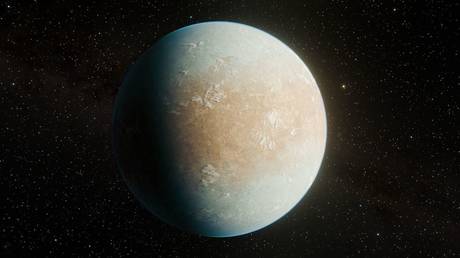
Hold on to your hats, folks! NASA has announced the discovery of a potentially habitable, Earth-sized planet orbiting a star remarkably similar to our own Sun. This tantalizing prospect, dubbed HD 137010 b, is located a cool 146 light-years away. While that sounds far (because, well, it *is* far!), it's still a significant step in our ongoing search for life beyond Earth. I mean, we're always looking, aren't we?
New Earth Found?! Scientists Stunned By Habitable ...
The discovery, detailed in a recent publication in *The Astrophysical Journal Letters*, was made possible by data collected way back in 2017 by NASA's Kepler Space Telescope during its extended K2 mission. An international team – shout out to the researchers from Australia, the UK, the US, and Denmark – painstakingly analyzed the data and spotted the telltale dimming of the star as HD 137010 b passed in front of it. This event, known as a transit, provided the crucial evidence of the planet's existence.
Here's where it gets interesting. HD 137010 b has an orbit of around 355 days, pretty darn close to our own year. However, being on the outer edge of its star's habitable zone means it receives considerably less warmth and light than Earth. We're talking less than a third! As a result, the surface temperature could plummet to a frigid -68 degrees Celsius (-90 degrees Fahrenheit). Think Mars, but maybe even colder.
But don't write it off just yet! Scientists speculate that a dense atmosphere, rich in carbon dioxide, could trap enough heat to make the planet habitable. A CO2-rich atmosphere could potentially bring it within the habitable zone. This is where things get exciting. A balmy, potentially life-sustaining world hiding under a blanket of greenhouse gases... it's a compelling picture, right?
Now, a word of caution: HD 137010 b is currently only classified as a "planet candidate." Only one transit has been observed so far. The long orbital period makes repeat observations a challenge. Confirmation will require further data, possibly from NASA's TESS satellite or Europe's CHEOPS mission. And maybe, just maybe, next-generation telescopes will give us an even clearer picture in the future.
Even with the uncertainties, the size, orbit, and the brightness of the host star make HD 137010 b a really promising target for future research. It could hold the key to understanding the prevalence of Earth-like planets throughout the galaxy. Who knows, perhaps, one day, we'll be able to say for sure whether this icy world is truly a haven for life. We can only hope, right?
Comments
Please sign in with Google to post a comment
No comments yet. Be the first to comment!