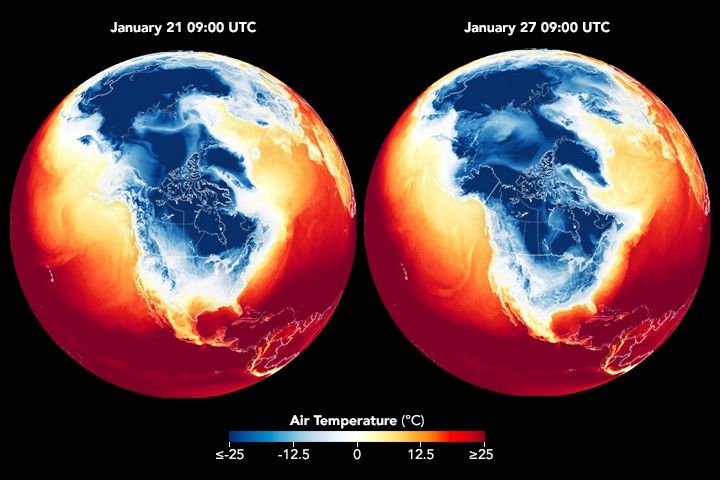
The Deep freeze of late January 2026 is one for the record books, at least for anyone living east of the Rockies. Following a brutal winter storm that blanketed a huge swath of the country with snow and ice, an equally punishing wave of Arctic air has settled in, turning everyday life into a battle against the elements. We're talking about the kind of cold that bites through your layers and makes you question every life choice that led you to be outside.
Arctic Blast Unleashes Fury: Is Your City Next?!
It's not just cold; it's persistently, stubbornly, bone-chillingly cold. The Deep freeze, lasting from January 21st to 29th, has been remarkable for its sheer intensity, how long it lasted, and the vast area it impacted. NASA's even released a striking animation based on satellite data and their GEOS model, showing the frigid air spreading like a dark, icy stain across North America. Those dark blue patches tell the story – this isn't your average winter chill.
The National Weather Service (NWS) pinpointed January 22nd as the day the Arctic express arrived, bringing with it temperatures that frankly, should be illegal. The initial cold front, combined with a jet stream packed with moisture, resulted in significant snowfall and ice accumulations stretching from the Southwest all the way to New England. I remember shoveling my driveway thinking, "This is it, I'm moving to Florida."
And the cold didn't let up after the storm passed. Alliance, Nebraska, for example, shivered through a -26°F (-32°C) reading on January 24th, a new record low for that date according to initial NWS reports. Even Texas, typically known for its mild winters, wasn’t spared, with an extreme cold warning issued for south-central areas, where temperatures dipped into the single digits. While some parts of the South saw a slight reprieve by January 27th, the Midwest and Northeast were still battling wind chills plummeting as low as -20°F (-29°C). Brutal.
Meteorologists are pointing the finger at frigid air masses originating from the Canadian and Siberian Arctic. Apparently, these Arctic blasts were channeled into eastern North America, driven south by high-pressure systems forcing the jet stream to take a nosedive. And the forecast? More of the same, unfortunately. Below-normal temperatures are expected to hang around well into early February. It's starting to feel like winter's got a personal vendetta against us.
Beyond the inconvenience, this prolonged cold is posing a serious threat to vulnerable populations. Those still without power or heat after the initial storm are facing a desperate situation. And the crews working tirelessly to clear roads, restore power, and get transportation back on track are doing so in incredibly harsh conditions. These are the real heroes right now.
Thankfully, NASA’s Disasters Response Coordination System has stepped in to support agencies dealing with the winter storm aftermath. They're providing crucial maps and data products through their open-access mapping portal, and that information will be vital in helping communities recover. Let's hope this deep freeze finally breaks soon; we could all use a little warmth.
Comments
Please sign in with Google to post a comment
No comments yet. Be the first to comment!