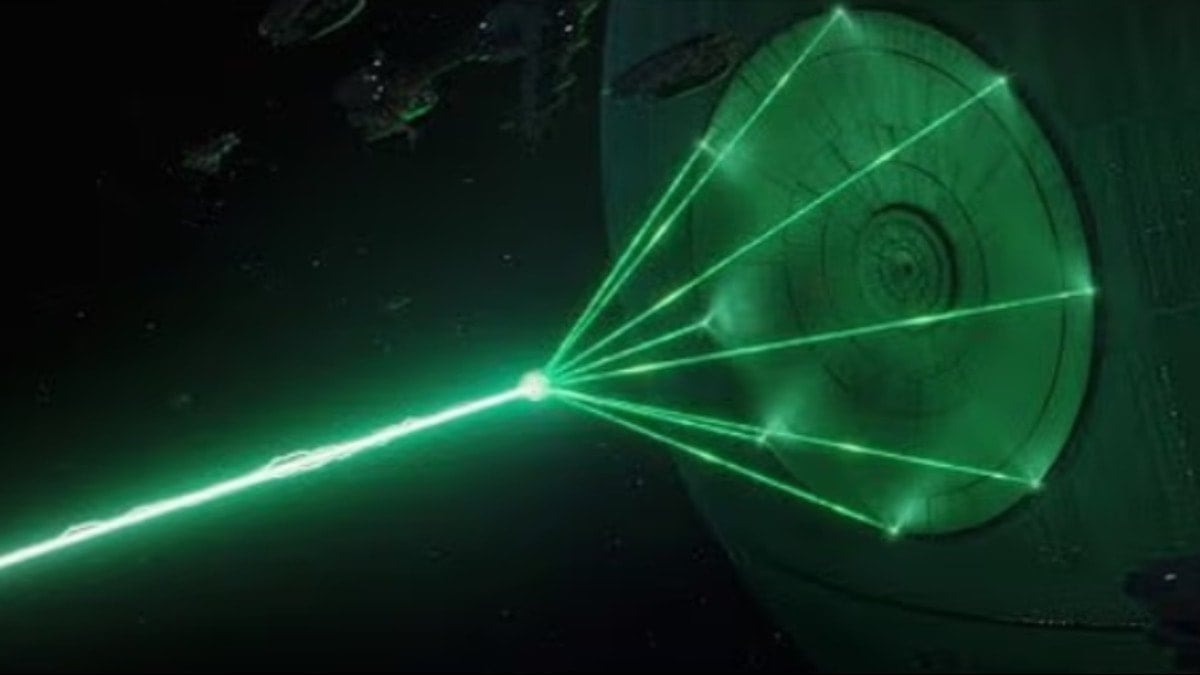
Astronomers have stumbled upon a cosmic burp of epic proportions: a supermassive black hole that's been belching out the remnants of a shredded star for the last four years. And when I say "epic," I mean this thing makes the Death Star from Star Wars look like a firefly. We're talking potentially the most energetic event ever observed, folks.
Black Hole EATS Death Star?! You Won't Believe the...
The experts are buzzing about the radio wave jets blasting from this black hole. Apparently, they could be among the brightest and most high-energy formations we've ever detected in the universe. Get this: calculations suggest the current energy outflow is *at least* a trillion times greater than what the Death Star could crank out. And it could be as high as 100 trillion. Let that sink in for a minute.
So, what exactly happened? Well, it's thought to be a "tidal disruption event," or TDE. Essentially, a star got a little too close for comfort to this black hole, and… well, it got torn apart. The Daily Mail was all over this, reporting that it started way back in 2018, about 665 million light-years away. Imagine that commute!
Now, black holes ripping apart stars isn't exactly new to astronomers. It's called "spaghettification" – a charmingly descriptive term for the extreme stretching and thinning that happens when a star gets caught in a black hole's gravity. But what's weird about this event is that the black hole didn't start blasting out all this energy until *years* after its stellar snack.
Researchers are scratching their heads. About three years after the initial star-shredding, this black hole suddenly started radiating massive amounts of energy in the form of radio waves. The latest study shows that energy has been increasing sharply, and it's now 50 times brighter than when it was first spotted. And here's the kicker: they think it's going to keep getting brighter, maybe even exponentially, before it peaks sometime in the next year.
"This is highly unusual," says Yvette Cendes, an astrophysicist at the University of Oregon and the lead author of the study. "We really haven't seen anything like this before. It's hard to think of another event that has shown such a prolonged increase in energy." I can only imagine the look on her face when the data started pouring in.
Officially, it's known as AT2018hyz, but the team affectionately calls it "Jetty McJetface." Gotta love scientists with a sense of humor, right?
When they crunched the numbers, the energy blasting from this black hole is comparable to a gamma-ray burst, putting it in the running for the most powerful singular event ever detected in the universe. Astronomers often call black holes "messy eaters" because they sometimes fling some of their food back into space. But usually, that happens pretty quickly. This sudden outburst, years later, has really thrown them for a loop.
The team plans to keep a close eye on Jetty McJetface in the coming years. Edo Berger of Harvard University, a co-author on the study, said back in 2022 that there was a three-year period of radio silence, and then boom, it transformed into one of the brightest radio-emitting TDEs ever seen. The latest findings have been published in *The Astrophysical Journal*. So, if you want to dive into the nitty-gritty details, that's the place to go. Fascinating stuff!
Comments
Please sign in with Google to post a comment
No comments yet. Be the first to comment!