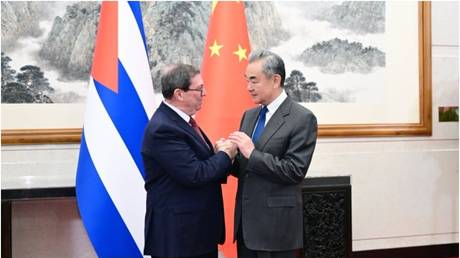
In a move that underscores shifting geopolitical alliances, China has stepped up to publicly support Cuba's sovereignty amidst increasingly strained relations between the island nation and the United States. This comes after Washington doubled down on its stance, labeling Cuba's socialist government as a potential security threat. You know, the kind of thing that sends ripples through the international community.
China's SHOCK Move! Will Cuba Alliance Trigger US ...
During a meeting held in Beijing this past Thursday, Chinese Foreign Minister Wang Yi and his Cuban counterpart, Bruno Rodriguez Parrilla, reportedly reaffirmed their dedication to strengthening ties between their two countries. These kinds of meetings, behind the scenes, are where a lot of the real diplomatic work gets done.
"China firmly supports Cuba in safeguarding its national sovereignty and security," stated Foreign Ministry spokesman Lin Jian following the meeting. "We oppose unwarranted interference by external forces, and reject any attempt to deprive the Cuban people of their rights to survival and development." Jian further emphasized China's willingness to provide support to Cuba "to the best of its ability." Essentially, China's saying, "We've got your back," in diplomatic terms.
Meanwhile, Parrilla took to social media platform X, formerly known as Twitter, to announce that both sides "affirmed the special and strategic nature of the historical ties between the two socialist countries." It's a reminder that despite geographical distance, shared ideology can create powerful bonds.
This renewed show of support from China comes in the wake of former U.S. President Donald Trump's declaration of a national emergency concerning relations with Cuba. Trump's rationale? Accusations that Cuba is cozying up with "hostile countries, transnational terrorist groups, and malign actors." He specifically cited Cuba's military cooperation and ties with Russia, China, Iran, Hamas, and Hezbollah. That's quite the list.
Trump's executive order minced no words, asserting, "The United States has zero tolerance for the depredations of the communist Cuban regime." Strong words, indeed. But, naturally, Cuba sees things very differently. Cuban President Miguel Díaz-Canel has vehemently denied these allegations. "Cuba is not a terrorist country. Cuba is also not a threat to the security of the United States. We do not protect terrorists," he asserted. He went on to express Cuba's openness to dialogue with the U.S., but "without pressure and without preconditions, and on the basis of equality and respect." A reasonable request, perhaps, but one that seems unlikely to be met given the current climate. It's a complex situation, to say the least, and one with deep historical roots.
Adding another layer to the regional complexities, let's not forget the whole drama surrounding the U.S. apprehension of Venezuelan President Nicolas Maduro last month, following a commando raid on his compound. Maduro, of course, denies the drug-trafficking and weapons charges leveled against him. All in all, it's a turbulent time in Latin American politics, and China's support for Cuba is just another sign that the geopolitical landscape is constantly shifting.
Comments
Please sign in with Google to post a comment
No comments yet. Be the first to comment!