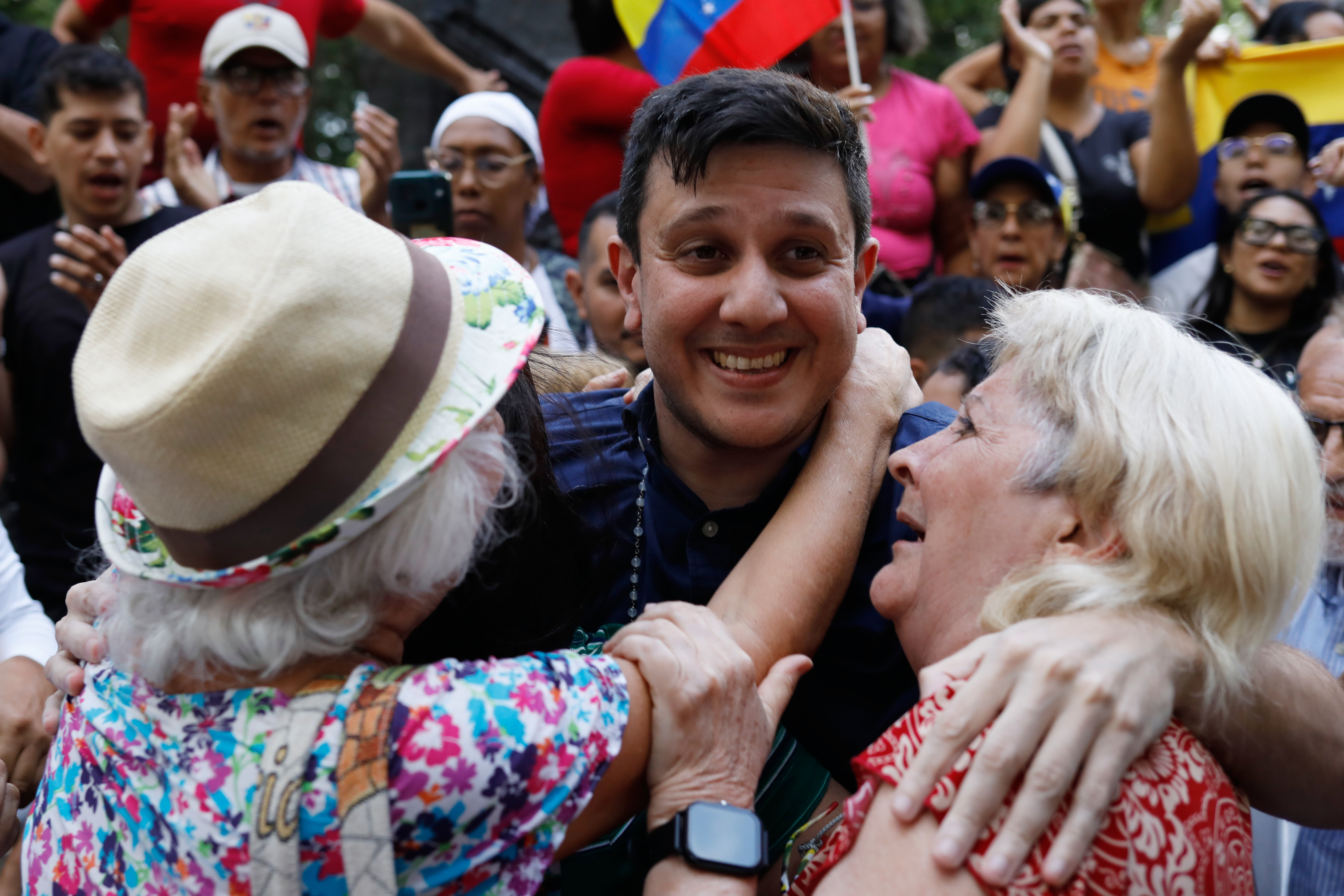
Venezuela's political landscape took a turn this weekend as several prominent opposition members were released from detention. This move comes amid mounting international and domestic pressure on the government of acting President Delcy Rodríguez to address the issue of political prisoners. It's a welcome development, no doubt, but questions remain about the scope and sincerity of these releases.
Venezuela SHOCK: Jailed Opposition FREED - What Ha...
Among those freed was a close associate of Nobel Peace Prize laureate Maria Corina Machado, a significant figure in the Venezuelan opposition. Juan Pablo Guanipa, held for over eight months on what many believe were trumped-up charges, was released from a Caracas detention facility. His release, captured in a brief video showing him with an armored vehicle and uniformed officers, underscores the ever-present tension and security concerns surrounding political activity in the country.
Foro Penal, a well-respected Venezuelan prisoners’ rights group, confirmed the release of at least 30 individuals on Sunday. This included members of Machado’s political organization, including Maria Oropeza, whose arrest was shockingly livestreamed as military intelligence officers allegedly broke into her home with a crowbar. Her attorney, Perkins Rocha, was also among those freed. Machado herself celebrated the releases on X, exclaiming, “Let’s go for the freedom of Venezuela!” It's a powerful message, but the road to true freedom and democratic reform is still long and arduous.
Guanipa's detention, back in May, stemmed from accusations leveled by Interior Minister Diosdado Cabello, alleging his involvement in a "terrorist group" plotting to boycott that month's legislative election. His brother, Tomás Guanipa, staunchly refuted these claims, arguing that the arrest was a blatant attempt to stifle dissent. This highlights a key issue: the criminalization of political opposition, a tactic often used by authoritarian regimes to silence critics.
"Thinking differently cannot be criminalized in Venezuela," Tomás Guanipa stated after the arrest. "He has the right to think as he thinks, the right to defend his ideas, and the right to be treated under a constitution that is not being enforced today." This statement really cuts to the heart of the matter. It’s about basic human rights and the rule of law, principles that are often trampled upon in Venezuela.
Rodríguez assumed the role of acting president after the rather dramatic capture of then-President Nicolás Maduro by the U.S. military last month. Following that event, her government announced intentions to release a significant number of prisoners, answering a key demand of the opposition, human rights organizations, and the United States. But the pace of these releases has been painfully slow, drawing criticism from families and rights watchdogs who feel like they're seeing token gestures rather than genuine change.
The National Assembly, which is largely controlled by the ruling party, has begun debating an amnesty bill that could potentially lead to the release of hundreds more prisoners. The opposition and NGOs are reacting with cautious optimism, tempered with a strong desire for more details about the proposal. After all, the devil is always in the details, isn't it?
Finally, it's worth noting that Delcy Rodríguez and Volker Türk, the U.N. High Commissioner for Human Rights, had a phone conversation in late January. Türk offered the UN's support in helping Venezuela develop a roadmap for dialogue and reconciliation with human rights at the center. A UN team has even been deployed to the country. Whether this international involvement will lead to meaningful and lasting change remains to be seen, but it offers a glimmer of hope in a complex and often disheartening situation.
Comments
Please sign in with Google to post a comment
No comments yet. Be the first to comment!