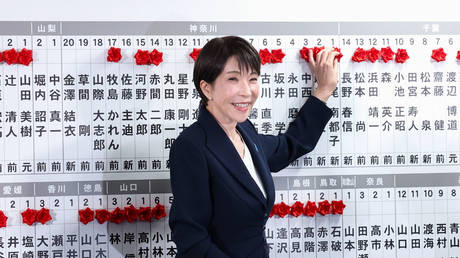
Japan's political landscape has just undergone a seismic shift. Prime Minister Sanae Takaichi and her Liberal Democratic Party (LDP) have clinched a historic victory in Sunday's snap parliamentary elections. The scale of the win is significant; with a supermajority secured in the lower house alongside coalition partners, Takaichi is now in a far stronger position to implement her agenda. And let me tell you, that agenda is likely to raise eyebrows, both domestically and internationally.
Japan Election SHOCKER! Landslide Victory - What H...
Takaichi, a known hardline conservative, became Japan's first female prime minister just last October. Her platform includes some fairly radical proposals, at least by recent Japanese standards. She's openly advocated for revising Japan’s pacifist constitution, a document that has shaped the nation's defense policy for decades. This isn't just about tweaking things around the edges; it’s about a fundamental shift in how Japan views its role in the world, particularly in terms of military capabilities. She wants to beef them up – significantly.
The snap election was, in many ways, a gamble. Takaichi clearly aimed to leverage her personal popularity to secure a mandate for what she called "major policy shifts." It appears the gamble paid off. Early reports suggest the LDP and its coalition partner, the Japan Innovation Party, are on track to secure at least 310 seats in the 465-member House of Representatives. That’s a level of dominance rarely seen in postwar Japanese politics.
What does this mean in practical terms? Well, with this overwhelming majority in the lower house, Takaichi can effectively bypass any resistance in the upper chamber. This dramatically increases the likelihood of constitutional amendments, a long-held ambition of the LDP's right wing. It’s a move that will undoubtedly be watched closely by Japan's neighbors, particularly China and Russia, who have already expressed concerns about the direction Japan is heading.
And speaking of Russia, the relationship between Moscow and Tokyo is already strained. Takaichi's predecessors in the LDP aligned Japan with Western sanctions against Russia following the Ukraine conflict. Moscow responded by withdrawing from peace talks, leaving the two countries still without a formal peace treaty to end World War II, due to a long-standing territorial dispute over the Kuril Islands. Add to that the increasing concerns voiced by Russian Foreign Minister Sergey Lavrov regarding Japan's growing militarization and the deployment of US weaponry, and you have a recipe for potential future tensions.
Beijing has also been vocal, condemning what it sees as attempts by "Japanese right-wing forces" to remilitarize the country and challenge the post-war international order. Takaichi herself has previously stated that Japan could respond militarily if China were to attempt to take Taiwan by force, a statement that certainly didn't go down well in Beijing. This election result is likely to exacerbate these existing tensions, potentially ushering in a new era of geopolitical complexity in East Asia. The world is watching closely to see how Prime Minister Takaichi will wield her newfound power.
Comments
Please sign in with Google to post a comment
No comments yet. Be the first to comment!