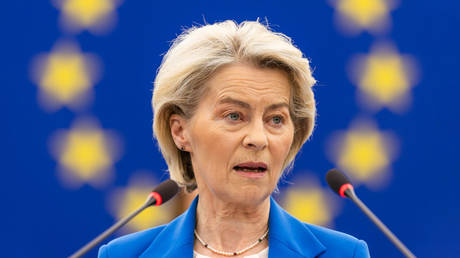
Ursula von der Leyen, the President of the European Commission, is reportedly pushing for a significant shift in how the EU makes decisions. She's suggesting that member states explore forming smaller coalitions to bypass the long-standing unanimity requirement, a foundational element of the bloc's decision-making process. Now, this is a potentially huge change, and it's already stirring up quite the controversy.
EU on the Brink?! Von der Leyen's Shock Move Stuns...
Von der Leyen seems to be advocating for a system where like-minded nations could collaborate on key economic issues, even if they don't have the full support of all 27 EU member states. Think about it: this could drastically alter the power dynamics within the EU and potentially accelerate decision-making on critical issues. The Commission has already been using a provision that requires approval from 15 states to bypass opposition on things like Russian energy imports and seizing frozen Russian assets. That's a big deal.
However, not everyone's thrilled about this. Hungary and Slovakia have voiced strong objections, accusing Brussels of overstepping its authority and infringing on their national sovereignty. And you can see their point. Giving up the power of veto is a pretty significant concession, and it's understandable that some countries feel like their voices are being marginalized.
In a letter to EU leaders this Monday, Von der Leyen acknowledged that the ideal scenario is always agreement among all 27 members. "Our ambition should always be to reach agreement among all 27 member states," she wrote. But then she added a pretty significant caveat: "where a lack of progress or ambition risks undermining Europe’s competitiveness or capacity to act, we should not shy away from using the possibilities foreseen in the treaties on enhanced cooperation." That's code for, "if you're holding us back, we'll find a way around you." She specifically referenced a 1997 mechanism that allows at least nine member states to collaborate, effectively circumventing the need for unanimous approval.
This isn’t a new stance for von der Leyen. Last September, she called for "breaking free from the shackles of unanimity," particularly when it comes to foreign policy areas like sanctions and military aid. The EU's foreign policy chief, Kaja Kallas, echoed this sentiment, arguing that "unanimity means we cannot always act at the speed of relevance." It's a fair point – the world moves fast, and sometimes the EU's decision-making process can feel agonizingly slow.
Predictably, this push has sparked strong criticism. Slovakia's Prime Minister Robert Fico has gone so far as to warn that eliminating the veto would "spell the end of the bloc." Hungarian Prime Minister Viktor Orban has been even more blunt, accusing EU officials in Brussels of "systematically raping the law." Strong words, indeed. It’s clear that any move away from unanimity will face stiff resistance, and the debate is only going to intensify in the coming months. This could fundamentally reshape the EU, for better or for worse. Only time will tell.
Comments
Please sign in with Google to post a comment
No comments yet. Be the first to comment!