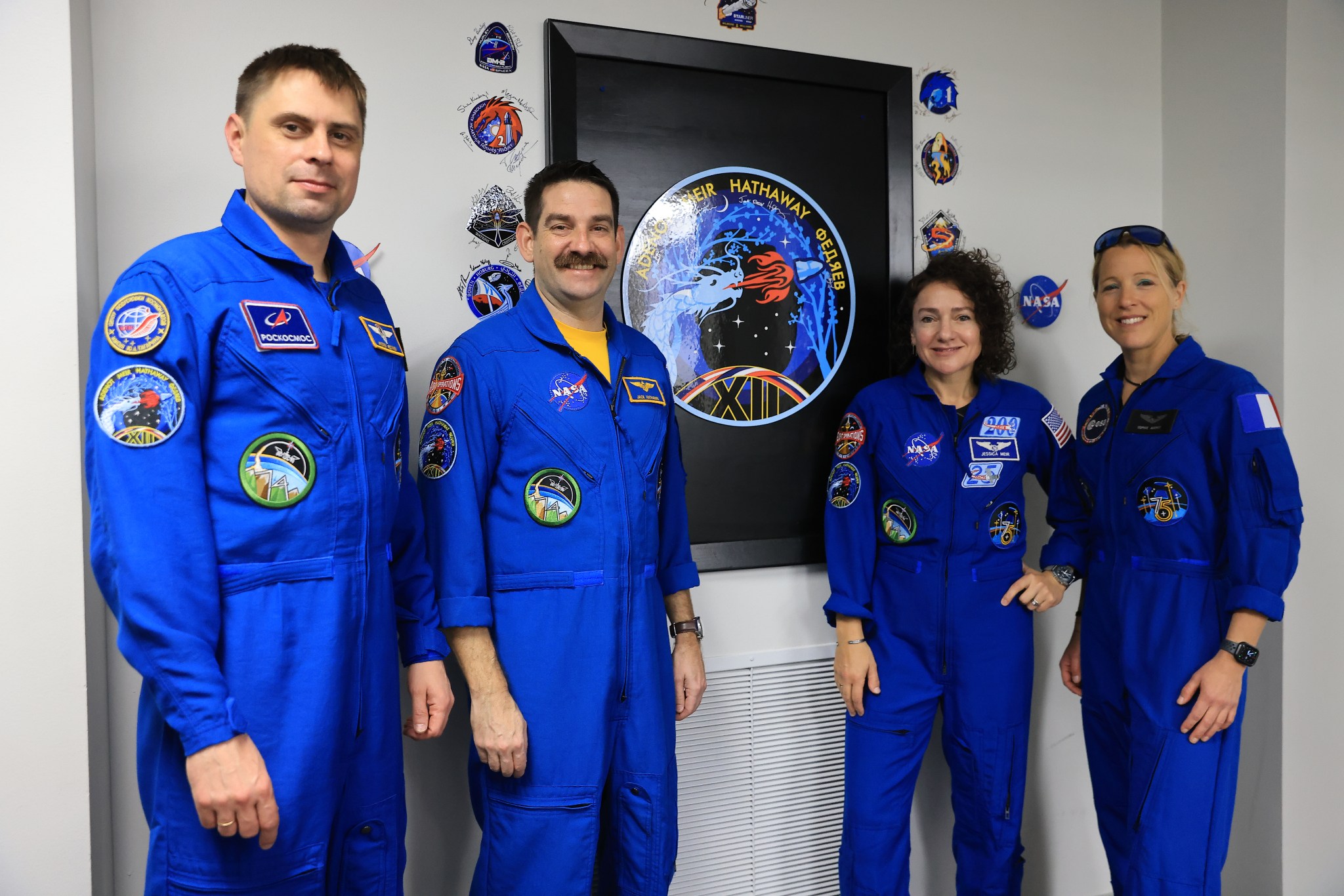
Get ready to look up! NASA's SpaceX Crew-12 mission is gearing up for launch, scheduled for no earlier than 5:15 a.m. EST this Friday, February 13th, from Cape Canaveral Space Force Station. The crew, a diverse team comprised of Roscosmos cosmonaut Andrey Fedyaev, NASA astronauts Jack Hathaway and Jessica Meir, and ESA (European Space Agency) astronaut Sophie Adenot, are all smiles in a newly released photo from NASA, posing beside their mission insignia.
Crew-12 Mission Patch REVEALED: What Does It REALL...
The photo, taken inside the Astronaut Crew Quarters at the Kennedy Space Center, offers a glimpse into the final preparations before their journey to the International Space Station (ISS). I always find these pre-launch images so fascinating; you can almost feel the anticipation and quiet focus in the room. These folks are about to embark on something truly extraordinary.
Crew-12 will be riding aboard a SpaceX Dragon spacecraft, propelled into orbit by a Falcon 9 rocket. Once at the ISS, they'll spend approximately eight months conducting a range of scientific experiments. And this isn't just about exploring space; the research they're undertaking has some seriously practical applications for us back here on Earth, as well as paving the way for future Moon and Mars missions.
So, what exactly will they be up to? The mission has a strong focus on biological and medical research. For instance, they'll be studying pneumonia-causing bacteria to find ways to improve treatments. This is critical, as pneumonia remains a significant health threat globally. They’ll also be working on developing on-demand intravenous fluid generation – which is not just for space travel but could also improve healthcare access in remote or disaster-stricken areas here on Earth.
Beyond health, the crew will be investigating ways to enhance food production in space. They're looking at plant and nitrogen-fixing microbe interactions, which could revolutionize how we grow food in challenging environments, both in space and potentially in areas affected by climate change here on our own planet. Let's face it: feeding people sustainably is one of the biggest challenges we face, so any advancements in this area are very welcome.
Finally, the mission includes research into how physical characteristics affect blood flow during spaceflight. Understanding these changes is crucial for ensuring the long-term health of astronauts on extended missions. It's amazing how many different areas of science are tied to this one mission. It really shows how interconnected everything is, and how space exploration can have a positive impact on our lives right here at home. Keep an eye on the skies Friday morning!
Comments
Please sign in with Google to post a comment
No comments yet. Be the first to comment!