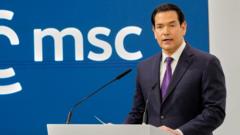
Munich – Amidst swirling questions about the future of Transatlantic relations, US Secretary of State Marco Rubio delivered a speech at the Munich Security Conference seemingly designed to soothe frayed nerves. He insisted that the US and Europe’s destinies are inextricably linked, a message that resonated strongly after a year of strained dialogues and, frankly, some outright scolding from across the pond.
Rubio's Shocking Claim: Is the US-Europe Alliance ...
Rubio’s core message was one of reassurance: "We do not seek to separate, but to revitalise an old friendship and renew the greatest civilisation in human history." It was a far cry from the tone struck by Vice-President JD Vance at the same event last year, who didn't mince words in criticizing European policies. This year felt different; a deliberate attempt to reset the narrative.
European Commission President Ursula von der Leyen, who's had her share of diplomatic tightropes to walk lately, clearly appreciated the shift. She described herself as "very much reassured" by Rubio's remarks. And, frankly, you could see the relief in her eyes. The unspoken worry in European circles has been whether the US is truly committed to the alliance, particularly given the political winds back home.
However, let's not paint too rosy a picture. Rubio didn't shy away from airing familiar grievances. He took aim at European immigration policies, branding them a threat, and even revived the somewhat tired accusation that a "climate cult" has hijacked economic policy. It was a reminder that while the tone might be more conciliatory, the fundamental disagreements remain.
On trade, Rubio suggested both sides were culpable, having embraced a "dogmatic vision of free and unfettered trade." He also echoed Washington's familiar refrain for increased European defense spending: "We want allies who can defend themselves so that no adversary will ever be tempted to test our collective strength." It's a point that's been hammered home for years, and one that continues to be a sticking point.
Beyond the transatlantic relationship, Rubio also took aim at the global order. He argued that the international system "must be rebuilt," singling out the UN for criticism, claiming it's been "powerless" in addressing conflicts like those in Gaza and Ukraine. He even questioned its ability to constrain Iran's nuclear ambitions, a particularly sensitive topic given recent saber-rattling from President Trump.
The backdrop to all of this, of course, is the ongoing war in Ukraine. President Zelensky, also speaking at the conference, reiterated his belief that Putin wouldn’t stop at Ukraine, painting a bleak picture of a Russia perpetually at war. The pressure on Zelensky to hold elections, despite the ongoing conflict, adds another layer of complexity to an already tense situation.
Ultimately, Rubio's speech represents a delicate balancing act. He's attempting to reassure allies while simultaneously appeasing a domestic audience that’s increasingly skeptical of foreign entanglements. Whether this charm offensive will be enough to truly mend fences remains to be seen. But for now, at least, the temperature in Munich has cooled a few degrees.
Comments
Please sign in with Google to post a comment
No comments yet. Be the first to comment!