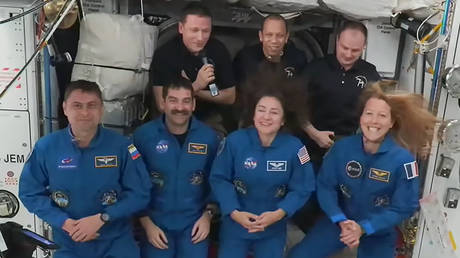
The International Space Station just got a little more crowded, and a whole lot more international! A SpaceX Crew Dragon spacecraft, carrying a diverse crew including Russian cosmonaut Andrey Fedyaev, successfully docked at the ISS this weekend, marking another significant step in international cooperation in space. Honestly, after all the geopolitical tensions lately, seeing this kind of collaboration is genuinely refreshing.
SpaceX Dragon Docks! What Happens Next Will Shock ...
Fedyaev hitched a ride alongside NASA's Jessica Meir (who's commanding the mission) and Jack Hathaway, plus the European Space Agency's Sophie Adenot, as part of the Crew-12 mission. The Dragon capsule, affectionately named 'Freedom' (a choice of name that definitely resonates!), launched atop a Falcon 9 rocket from Cape Canaveral on Friday. After a relatively brief 34-hour journey, the reusable capsule linked up with the station’s Harmony module, delivering its precious human cargo to their orbital home.
The moment of docking sounded pretty profound. Meir radioed back to Earth with some powerful words, saying, "With that gentle contact, we have bridged the legacy of humankind’s continuous presence in space. It has been more than 25 years at this very site... The International Space Station is more than a structure, it is a promise kept. Decades in the making, built by nations, sustained by trust and partnerships, and powered by science, innovation and curiosity." You can almost feel the weight of history in those words, can't you?
She continued, adding another layer of optimism: "As we look back at Earth through these windows, we are reminded that cooperation is not just possible, it is essential. Up here there are no borders and hope is universal." It’s a sentiment we could all use a little more of down here on terra firma. I think it’s easy to forget, when you're constantly bombarded with news of conflict, that there are still pockets of remarkable collaboration happening, pushing the boundaries of what’s possible.
Now, these astronauts are settling in for a long stay – around eight months – during which they'll be busy with a whole host of activities. Think scientific research (the kind that can only be done in microgravity), essential maintenance to keep the ISS running smoothly, and the testing of cutting-edge technologies that could shape future space exploration. Their arrival also brings the station back to its full seven-person capacity, which is crucial for maximizing the output of research and operations.
This mission is especially significant because it underscores the ongoing collaboration between Russia and the United States in space, despite the current challenges in their relationship on Earth. The cross-flight agreement, established in 2022, is allowing for the exchange of personnel, ensuring that both Roscosmos cosmonauts and NASA astronauts have access to both Crew Dragon and Soyuz spacecraft. NASA Administrator Jared Isaacman also mentioned plans to meet with Roscosmos Director General Dmitry Bakanov soon, signaling a continued commitment to working together. He's even planning on attending the Soyuz MS-29 launch in 2026! That's dedication.
Comments
Please sign in with Google to post a comment
No comments yet. Be the first to comment!