Scientists map a ‘Magnetic Highway’ in distant Galaxy Arp 220 and it could change how we understand the early universe
Shocking Discovery: 'Magnetic Highway' Found! What...
By Farah Mokrani • Published: February 15, 2026 • 9:30 PM • 3 minutes read
Alright, buckle up, space fans, because astronomers have just mapped something truly extraordinary in the distant galaxy system Arp 220: a massive, and surprisingly organized, Magnetic field. We're talking a "magnetic highway" transporting galactic material. And honestly, the implications could rewrite our understanding of the early universe.
Located roughly 250 million light-years away (a cosmic stone's throw, relatively speaking), Arp 220 is a galaxy merger, offering a valuable, almost time-traveling, glimpse into the wild behavior of massive galaxies from over ten billion years ago, back when the universe was a far more chaotic place. Think of it as peeking into a galactic construction zone.
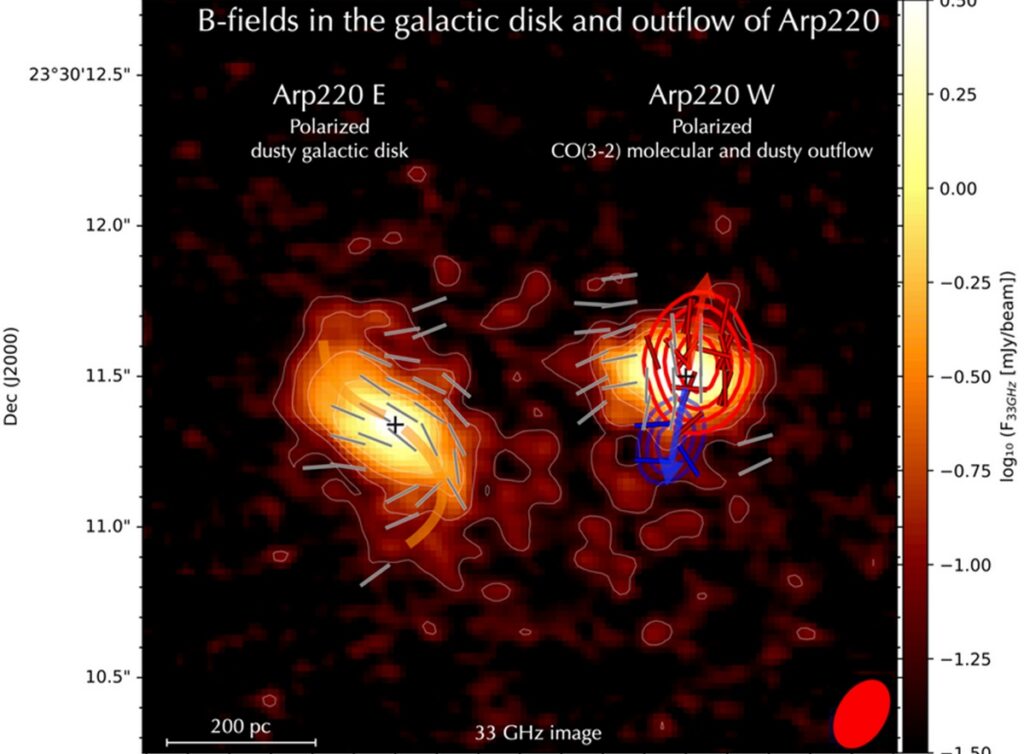
The breakthrough came from studying polarization – basically, how light waves are aligned by dust grains and carbon monoxide molecules under the influence of a Magnetic field. By mapping these alignments, researchers discovered a seriously impressive feature: in one of Arp 220's galactic cores, the magnetic field forms a structured, almost vertical pathway. And matter is flowing outwards along this "highway" at incredible speeds.
Instead of just being a passive background player, the magnetic field seems to be actively guiding and channeling gas away from the galactic center. Hence, the term "magnetic highway." In the western nucleus, the magnetic structure lines up perfectly with a bipolar outflow, suggesting it's directly launching or shaping that outflow. Pretty cool stuff.
But it gets even more interesting. The eastern nucleus tells a different story. There, astronomers found a spiral magnetic pattern embedded within a dense, rotating disk. And get this: a polarized dust bridge even connects the two galactic centers, hinting that magnetism is influencing the entire merger process. It's like the magnetic fields are the unsung choreographers of this cosmic dance.
Previously, many scientists believed that these kinds of extreme galactic outflows were mainly powered by explosive star formation or supermassive black hole shenanigans. But the magnetic fields measured in Arp 220 are hundreds, even thousands, of times stronger than what we typically see in our own Milky Way. That's not just background noise; that's a major force at play. They can absolutely influence gas movement, star formation rates, and how galaxies shed material over their lifetimes.
The real kicker? If similar magnetic structures were common in the early universe, they could have profoundly shaped how galaxies evolved on a grand scale. The research team now plans to use the same mapping techniques on other merging or dust-rich galaxies. Finding similar magnetic "highways" elsewhere would solidify the idea that magnetism is a fundamental engine of galactic evolution, not just a supporting role.
Magnetic fields are invisible, sure, but they're far from insignificant. In the vastness of space, where gravity and radiation often steal the spotlight, magnetism has sometimes been considered a secondary factor. These findings are seriously challenging that assumption.
What we're seeing in Arp 220 could be a reminder that galaxies are shaped not only by raw explosive power but also by structured, organized forces operating quietly in the background. Arp 220 is showing us that invisible magnetic structures can organize chaos on a galactic scale. And if these structures were common in the early days of the universe, well, they may have played a central role in building the cosmic landscape we see today.
Comments
Please sign in with Google to post a comment
No comments yet. Be the first to comment!