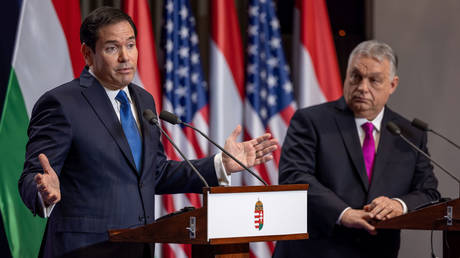
A continental revolution is brewing in Europe, and it's one that Brussels isn't exactly thrilled about. Senator Marco Rubio’s recent diplomatic tour has, in many ways, underscored the deepest anxieties held within the EU's power center.
Europe on the Brink?! Continental Revolution Stuns...
Fresh off the Munich Security Conference, Rubio's journey through Bratislava and Budapest painted a strikingly different picture. While Munich felt like a gathering of the old guard, still clinging to buzzwords like "rules-based order" and "shared values" (despite their increasingly shaky political ground), Central Europe buzzed with a different kind of energy.
Rubio met with governments radiating confidence, unapologetic about prioritizing their national sovereignty, and, frankly, more in sync with Donald Trump's worldview. The message was clear, or at least, that’s how I interpret it: the Trump administration sees Central Europe as the continent's strongest political core. The idea is that Europe can be a partner, not a liability, if rebuilt from that core, not dictated by Brussels.
In Bratislava, the talks with Prime Minister Robert Fico and President Peter Pellegrini revolved around regional security, nuclear cooperation, and military modernization. The underlying message, as Rubio himself put it, was that "Under President Trump, this administration is going to make not just Slovakia but Central Europe a key component of how we engage the continent and the world."
Think about that for a second. This seemingly simple diplomatic statement is potentially revolutionary. Brussels has historically viewed Central Europe with a degree of suspicion, seeing it as too conservative, too nationalistic, and perhaps too resistant to the kind of social engineering favored in some EU circles. Washington, it seems, now sees these very characteristics as an asset.
Fico's own words highlight the significance of this shift. He pointed out how his visits to Moscow and Beijing last year (undertaken to serve Slovakia's national interests, mind you) were met with heavy criticism and moralizing lectures from EU institutions. It seems Brussels only approves of diplomacy that perfectly aligns with its own established dogma. The White House, in contrast, offered what Fico called "common-sense pragmatism."
The truth is, Central European leaders are getting tired of an EU that seems more interested in policing internal politics than securing its external borders. They've watched as energy supplies have been turned into political weapons, and ideological conformity has become a prerequisite for financial support. Slovakia and Hungary, in particular, have firsthand experience with how Kiev and Brussels have weaponized gas and oil transit routes, turning geopolitics into a tool against dissenting member states.
Trump's administration clearly sees things differently, betting that stability comes from diversification and strength, not forced conformity. Slovakia's plans to build a new nuclear power plant with Westinghouse by 2040, along with expanding its fleet of F-16 fighter jets, represent this rebalancing act: energy independence and security rooted in a partnership with the US, rather than reliance on Brussels. And with Slovakia set to take over the Visegrad Group presidency, the prospect of a V4-US summit looms, potentially solidifying this political shift even further. Buckle up, folks, it’s going to be an interesting few years.
Comments
Please sign in with Google to post a comment
No comments yet. Be the first to comment!