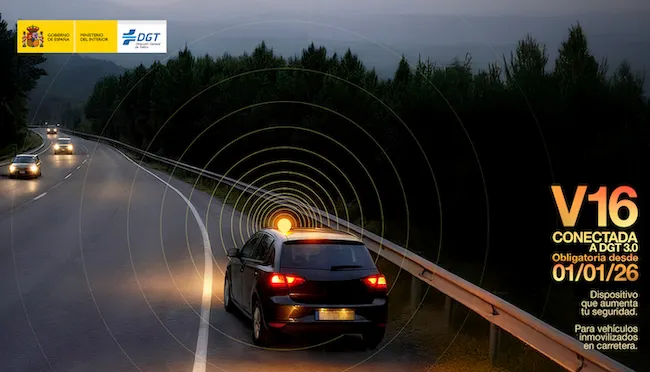
Madrid – Just when you thought you had a handle on the ever-changing rules of the road, another potential snag appears. The European Commission is now poking holes in Spain's recent mandate requiring all drivers to carry V-16 emergency lights, questioning whether the device actually complies with EU law. Talk about a headache!
Spain's V-16 Lights Face EU Scrutiny: Are They Ill...
For those not in the know, the V-16 light is a flashing beacon intended to replace the traditional, and frankly quite dangerous, roadside triangle. The idea is simple: stick it on your car roof after a breakdown or accident, and it alerts oncoming traffic. Makes sense, right? Well, the Spanish government thought so, making them obligatory for all 28 million drivers in the country. But there's a catch.
The problem? The Commission is reportedly concerned about whether the V-16 lights adhere to the EU's regulations on product standardization and free movement of goods. It boils down to this: Does the specific Spanish standard for these lights create a barrier to other, equally safe and effective emergency beacons that might be approved in other EU countries? And let's be honest, nobody likes protectionism when it comes to potentially life-saving devices.
Now, I’ve seen these V-16 lights in action, and they *are* noticeably brighter and more visible than relying on hazard lights and triangles alone, especially at night. The magnetic base is also a definite plus, allowing you to attach it quickly without having to risk your life dodging traffic to set up a triangle. But the question of legality under EU law is a valid one, and it has potentially significant implications.
If the Commission finds Spain's V-16 requirements to be non-compliant, it could force the country to revise its rules, potentially delaying the implementation of the mandatory light or even opening the door to a wider range of approved devices. This throws a wrench in the plans of millions of Spanish drivers who have already shelled out around €50 for these gadgets. It also puts manufacturers in a precarious position.
This whole saga highlights the often-complex interplay between national regulations and EU law. While safety improvements are always welcome, they need to be implemented in a way that respects the principles of free trade and fair competition within the European Union. It's a sticky situation, and one I'll be following closely. Stay tuned, drivers – this story is far from over.
Comments
Please sign in with Google to post a comment
No comments yet. Be the first to comment!