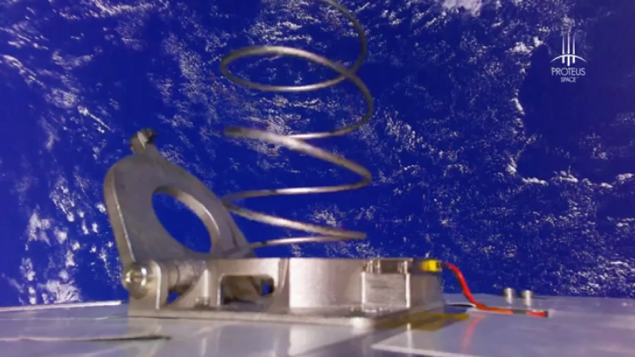
Okay folks, this is pretty cool. NASA's Jet Propulsion Laboratory (JPL) just showcased something that could seriously revolutionize how we build space antennas. Forget about clunky, expensive, and complex parts; they’ve successfully tested a 3D-printed spring that’s basically a jack-in-the-box for space.
JPL's 3D-Printed Part Just Did *This*?! Engineers ...
This isn't just some theoretical exercise either. This little marvel, dubbed the JPL Additive Compliant Canister (JACC), was actually launched into space! It hitched a ride on Proteus Space’s Mercury One spacecraft back on February 3, 2026. And guess what? It worked perfectly. An onboard camera even captured the spring popping out of its container as the spacecraft zipped over the Pacific Ocean. Talk about a photo op!
JACC, along with another JPL payload, is all about shrinking the size and weight of antenna deployment systems while maintaining pinpoint accuracy. Think about it: less weight means less fuel, less cost, and more room for other important gadgets on future space missions. A still image showing JACC after its deployment was even snapped above Antarctica. Pretty neat, right?
The really amazing thing is how much simpler this 3D-printed approach is. According to JPL, JACC uses three times fewer parts than comparable traditionally manufactured structures. It's all thanks to titanium printing, allowing them to combine a hinge, panel, compression spring, and two torsion springs into a single, unified component. It’s more like a single, cleverly designed piece, if that makes sense. It only weighs a bit over a pound and is about 4 inches on each side when packed, but it extends to about 6 inches when deployed. You can see how that makes it easier to get into orbit.
And this isn't some one-off experiment. JACC is part of a larger project called PANDORASBox (Prototype Actuated Nonlinear Deployables Offering Repeatable Accuracy Stowed on a Box), which also includes the Solid Underconstrained Multi-Frequency (SUM) Deployable Antenna for Earth Science. JPL designed, built, tested, and delivered both of these payloads for flight in under a year on a shoestring budget. That's impressive speed and efficiency!
Mercury One, the spacecraft carrying all this cool tech, launched from Vandenberg Space Force Base in California on November 28, 2025, as part of SpaceX’s Transporter-15 mission. So, next time you're looking up at the stars, remember that a little 3D-printed spring might just be the key to unlocking future discoveries about our planet and the universe beyond. Pretty impressive, if you ask me.
Comments
Please sign in with Google to post a comment
No comments yet. Be the first to comment!