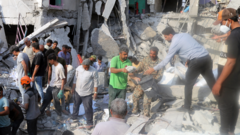
A devastating strike on a school in southern Iran has left a reported 153 people dead, many of them children, sparking a furious blame game between Iran, the US, and Israel. Iranian officials are pointing fingers squarely at Washington and Tel Aviv, accusing them of a deliberate attack on the girls' school in Minab, a town close to a sensitive military installation.
School Strike Horror: 153+ Dead – What Happens Nex...
The US military's Central Command (Centcom) is, according to official statements, "investigating" the grim reports. Israel, for its part, has offered a somewhat vague denial, stating its military, the IDF, is "not aware" of any operations in that specific area. This kind of carefully worded statement often leaves room for interpretation, and frankly, doesn't exactly inspire confidence in definitive denials.
The school, nestled in Minab, Hormozgan province, was reportedly struck by three missiles. This proximity to a base belonging to the Islamic Revolutionary Guard Corps (IRGC), a group that’s been in the crosshairs before, raises troubling questions. The Iranian Red Crescent's figures paint an even grimmer picture, claiming at least 201 fatalities and a staggering 747 injuries from airstrikes across Iran since Saturday.
President Masoud Pezeshkian has come out swinging, denouncing the incident as a "barbaric act" and adding it to the "black record" of alleged aggressors. Centcom spokesman Tim Hawkins, in a statement released to US media, said they are taking the reports "seriously," emphasizing the importance of civilian protection and vowing to minimize unintended harm. Words are easy, of course; the impact on the ground is what truly matters.
Independent verification of the death toll is proving difficult, a frustratingly common hurdle in reporting from Iran. International news organizations often face visa restrictions, severely limiting access and the ability to gather reliable, firsthand information. The BBC did manage to verify footage showing smoke billowing from a building and capturing the sounds of panic, but that's just a small piece of a much larger, and tragically opaque, puzzle.
The tragedy has ignited a firestorm on Iranian social media. While some Iranians abroad vehemently condemn the attack and its impact on civilians, others, deeply distrustful of the regime, are laying blame at the feet of their own government. This internal division, fueled by years of political repression and economic hardship, complicates the narrative and makes it difficult to discern the full truth. One user argued that even if the regime didn't directly target the school, its failure to provide adequate shelter or warnings makes it culpable in the deaths of these children. It's a complex situation, to say the least, and one that demands careful, nuanced reporting – even if that reporting is often done from a distance.
Comments
Please sign in with Google to post a comment
No comments yet. Be the first to comment!