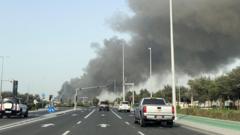
Allies of US in the Gulf Bear Brunt of Iran attacks
Gulf Allies Under Fire: Will US Retaliate?!
Iran's recent attacks targeting Gulf Arab states paint a worrying picture. It strongly suggests the Islamic Republic is expanding its target list, moving beyond just US military assets to include civilian infrastructure. This shift in strategy is deeply concerning for the region and highlights the growing instability in the Middle East.
Up in the skies above Abu Dhabi, it’s not hard to spot them – contrails slicing through the bright blue, high above the city's landscape. But these aren't the familiar trails of commercial flights bringing in tourists. These vapor trails are the telltale signatures of incoming ballistic missiles, launched by Iran, the Emirates' increasingly aggressive neighbor across the Gulf.
The United Arab Emirates (UAE) defense ministry reported intercepting, just this last Sunday, a staggering 165 incoming ballistic missiles, alongside two cruise missiles and a jaw-dropping 541 Iranian drones. That's a lot of hardware to be throwing around, and it underscores the scale of the threat these nations are facing.
In Bahrain, I received a text message Sunday morning from a resident who’d clearly had a rough night. "Woken by huge bangs and wailing siren," it read. "I think maybe around 20 booms and bangs. At least two hits." This kind of personal testimony really drives home the reality of the situation on the ground. It’s not just numbers and statistics; it’s people’s lives being disrupted and put at risk.
Luxury hotels, busy shopping malls, high-rise apartment buildings, and those gleaming, state-of-the-art airport terminals are now sporadically taking hits. Gaps are appearing in the Gulf Arab states' air defenses. These structures were never designed to withstand drone and ballistic missile attacks, and the vulnerability is now painfully obvious.
Interestingly, Iranian Foreign Minister Abbas Aragchi denied targeting his country's neighbors, claiming to Al Jazeera: "We are not attacking our neighbors in the Persian Gulf countries; we are targeting the presence of the US in these countries. Neighbors should direct their grievances to the decision-makers of this war." It's a carefully worded statement, but the evidence on the ground tells a different story.
While some damage to civilian infrastructure can be chalked up to debris from intercepted missiles, the sheer volume of attacks on airports in Bahrain and the UAE points to something more deliberate. It's difficult to believe it's just coincidence.
Iran had previously warned of retaliation against any country deemed complicit in attacks against it. The Gulf states, while attempting to maintain a semblance of neutrality in the US-Israeli conflict, seem to be paying the price for their long-standing military partnership with Washington. It's a precarious position to be in, caught between powerful allies and a hostile neighbor.
Before the Islamic Revolution, under the Shah, Iran was known as "the policeman of the Gulf." Since then, it has tried – unsuccessfully - to convince its neighbors to let it resume that role, "taking charge of security" in what it calls Khaleej-e-Fars, the Persian Gulf (Arabs call it the Arabian Gulf). It's a power play, plain and simple.
Iranian leaders have repeatedly attempted to persuade the Arab states in the Gulf to kick out the US Navy and embrace them as protectors. But for the rulers of these states – conservative, dynastic monarchies deeply suspicious of the Islamic Republic's revolutionary zeal – a line has been crossed. It is hard to see a return to normal relations with the current Iranian leadership.
Saudi Arabia and Oman, both long-time hosts of US and Western military forces, have so far escaped the brunt of these attacks, compared to the other four Gulf Arab states. The Saudi capital, Riyadh, does appear to have been targeted on a number of occasions.
Comments
Please sign in with Google to post a comment
No comments yet. Be the first to comment!