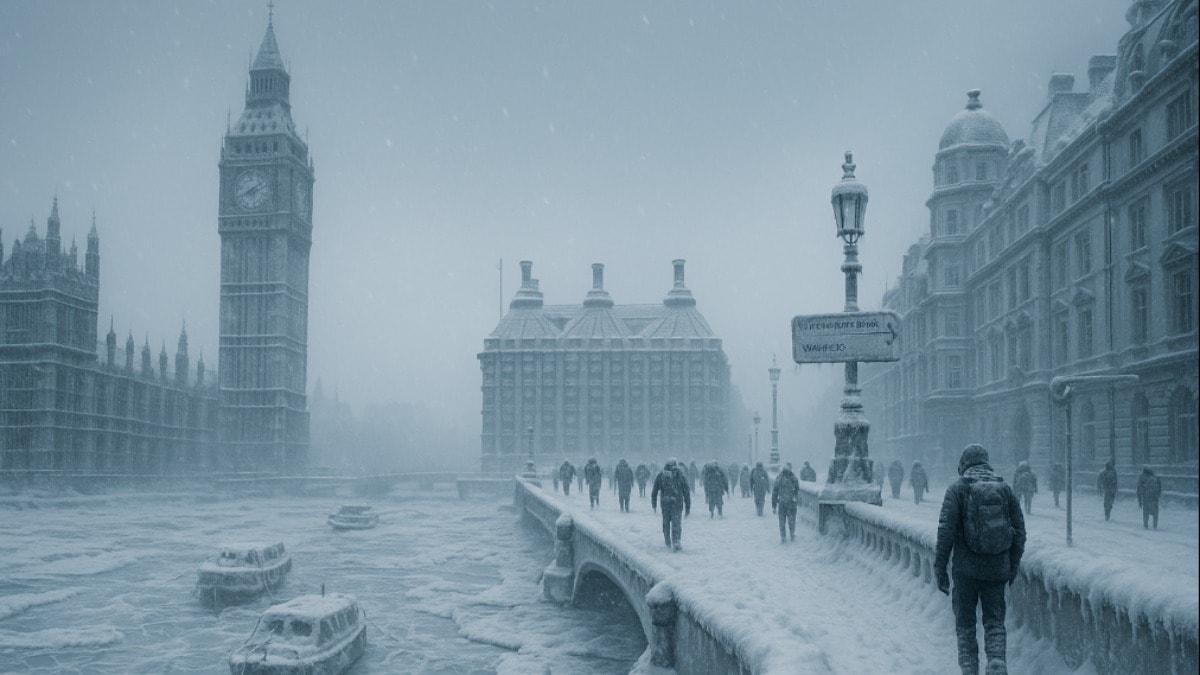
Gulf Stream Collapse: Are We Heading for a New Ice Age?
Global Chill: Are We Headed for a New Ice Age?
The Atlantic Meridional Overturning Circulation (AMOC), a vital ocean current system often referred to as the Gulf Stream, is showing alarming signs of weakening, raising concerns that Europe and North America could face drastically colder temperatures this century. A new study suggests that a collapse of this system, reminiscent of the scenario depicted in the movie "The Day After Tomorrow," is a real and growing threat.
Scientists from the Institute of Oceanology of the Chinese Academy of Sciences and experts in San Diego have identified a critical indicator of AMOC's weakening: unusually warm ocean water at depths of 1000-2000 meters. This deep-water warming, less susceptible to atmospheric influences, serves as a more reliable fingerprint of AMOC's strength than surface temperature measurements alone.
The Ocean Conveyor Belt Slowing Down
AMOC functions as a massive ocean conveyor belt, transporting warm tropical waters northward near the surface. This process helps maintain the relatively mild climate enjoyed by Europe, the United Kingdom, and the eastern coast of the United States. However, the influx of freshwater from melting glaciers in Greenland is disrupting this delicate balance, causing the system to slow down.
Potential Consequences: A Deep Freeze
The implications of an AMOC collapse are severe. Experts predict that temperatures in Europe could plummet by as much as 15°C, leading to extreme winter conditions reaching -30°C in some areas. The disruption to the temperate air balance could usher in a new ice age scenario characterized by persistent snow, ice, and frigid temperatures. The Icelandic Minister of Climate has even described the situation as a "direct threat to national security," highlighting the urgency of the situation.
Researchers analyzed climate models, ocean simulations, and observational data to assess AMOC's behavior over the next 75 years. Their findings indicate that the system began weakening in the late 20th century, with a significant increase in deep-water temperatures since the 2000s. Simulations using the MITgcm model revealed that a slowing AMOC leads to warming in the sublayers of water in the North Atlantic, generating baroclinic Kelvin waves that propagate towards the equator, causing mid-depth warming.
The study underscores the critical role AMOC plays in regulating global climate. A complete collapse would drastically reduce the amount of heat transported to the northern hemisphere, potentially plunging large parts of Europe into a deep freeze and triggering a cascade of unforeseen environmental consequences. While further research is needed to refine the timeline and specific impacts, the current findings serve as a stark warning about the potential for abrupt and devastating climate change.
Comments
Please sign in with Google to post a comment
No comments yet. Be the first to comment!