Ukraine Secures Landmark Deal for Rafale Fighter Jets and Advanced Air Defenses
Ukraine's Air Force Set to Soar: 100 Rafales Could...
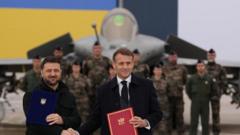
In a move hailed as "historic," Ukraine has secured a significant agreement with France for the acquisition of up to 100 Rafale F4 fighter jets and advanced air defense systems. The deal, formalized through a letter of intent signed by President Volodymyr Zelensky and French President Emmanuel Macron, aims to bolster Ukraine's ability to defend itself against escalating Russian air attacks. Deliveries of the Rafale jets are slated to begin with joint production of interceptor drones starting this year and concluding by 2035.
The agreement comes as Russia intensifies its aerial bombardment of Ukrainian infrastructure, targeting energy and rail networks and causing widespread blackouts. Kyiv and its Western allies have condemned these attacks as war crimes, citing the numerous civilian casualties. Just recently, a Russian missile strike on Balakliya claimed the lives of three and injured fifteen.
A Strategic Partnership for the Long Term
While financial details remain under discussion, reports suggest France intends to leverage EU funding and potentially tap into frozen Russian assets to finance the deal – a move that has sparked debate within the European Union. President Zelensky emphasized the strategic nature of the agreement, stating it would span ten years, commencing next year. In addition to the Rafale jets, Ukraine is set to receive advanced French radars and eight air defense systems, further enhancing its defensive capabilities. Zelensky underscored the importance of these systems in protecting human lives.
Impact and Challenges Ahead
Macron, speaking alongside Zelensky, emphasized the scale of the agreement, calling the planned delivery of 100 Rafale jets "huge" and essential for the "regeneration of the Ukrainian military." The French President reiterated his commitment to assisting Ukraine in preparing for future challenges. These Rafale fighter jets are crucial to protecting Ukraine's skies, because the country is almost powerless in preventing long-range air strikes on its border towns and cities.
However, experts caution against expecting an immediate shift in the conflict's dynamics. Justin Bronk of the Royal United Services Institute (RUSI) notes that the effectiveness of the Rafale jets will depend on the timeframe of their delivery and the accompanying missile systems. He emphasizes that the agreement is primarily a long-term political commitment, rather than an immediate procurement order. Furthermore, the promises of Western military hardware are only as effective as the training and logistics they come with.
Comments
Please sign in with Google to post a comment
No comments yet. Be the first to comment!