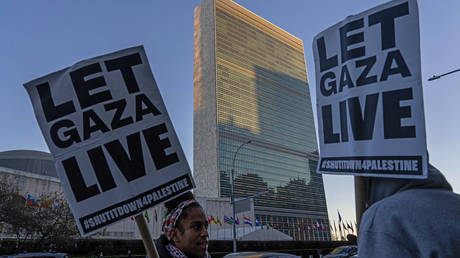
UN Backs Trump-Era Gaza Plan, Authorizing International Stabilization Force Amidst Concerns
The United Nations Security Council has approved a US-drafted resolution endorsing a peace plan for Gaza and authorizing the deployment of an “International Stabilization Force” (ISF) to the region. The resolution, a remnant of the Trump administration's foreign policy initiatives, aims to oversee the demilitarization of the Palestinian enclave and foster a more stable environment.
Gaza's Future: UN Greenlights Trump-Era Plan for "...
The move, passed on Monday, saw Russia and China abstain from voting, highlighting lingering concerns about the plan's practical implementation and its potential impact on the long-sought two-state solution. The resolution formally supports a multinational ISF, envisioned to comprise contingents from Arab nations and other countries, operating under the command of a transitional governance body known as the Board of Peace (BoP). The ISF's mandate includes providing security, training a new Palestinian police force, and overseeing both the demilitarization and redevelopment efforts within Gaza.
US Ambassador Mike Waltz hailed the
US Ambassador Mike Waltz hailed the resolution as a crucial step towards a secure and prosperous Gaza, enabling Israel to live in greater security. He emphasized the ISF's role in dismantling terrorist infrastructure and supporting the demilitarization process.
However, the resolution has drawn criticism. Russian Ambassador Vassily Nebenzia expressed reservations, calling the document a "pig in a poke" and voicing concerns that the Council was placing undue faith in Washington's intentions. He warned against the resolution becoming a smokescreen for potentially detrimental experiments by the US and Israel within the occupied Palestinian territory, potentially jeopardizing the two-state solution. Despite these reservations, Russia ultimately abstained from vetoing the resolution, citing the support of numerous Arab states for the American proposal.
Hamas, the de facto governing authority in Gaza, has also strongly condemned the resolution. The organization argues that the ISF's mandate to disarm militant groups compromises its neutrality and effectively transforms it into a party aligned with the "occupation," a term used to describe Israel's presence in Palestinian territories.
The UN's endorsement of the US-drafted resolution marks a significant, albeit controversial, step towards stabilizing Gaza. While proponents emphasize its potential to foster security and development, critics remain wary of its practical implications and its impact on the broader Israeli-Palestinian conflict. The success of the ISF and the BoP will depend heavily on international cooperation, transparency, and a commitment to addressing the underlying causes of instability in the region. The path forward remains uncertain, with potential pitfalls and challenges looming large.
Comments
Please sign in with Google to post a comment
No comments yet. Be the first to comment!