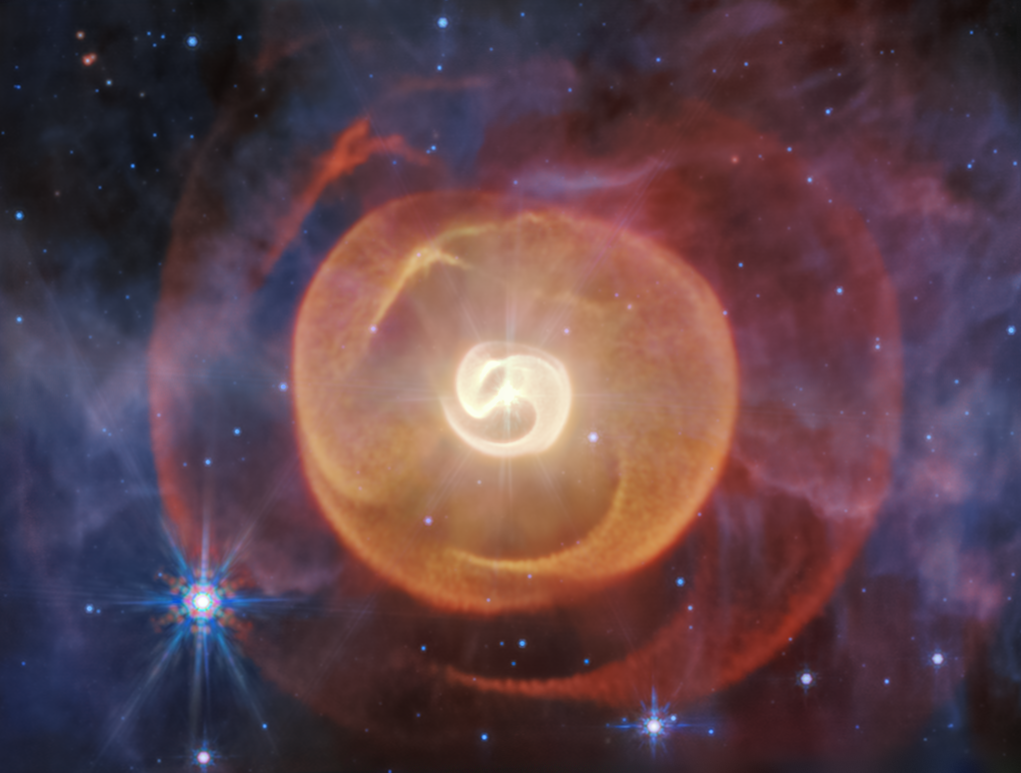
Webb Telescope Unveils Stunning Spiral Dust Shells Around Chaotic Star System Apep
Folks, sometimes you see an image and you just have to stop and stare. NASA's James Webb Space Telescope has delivered one of those moments. It's a stunning, almost hypnotic view of four spiraling dust shells emanating from a volatile star system known as Apep. What makes this so extraordinary? Well, prior to Webb, we only knew about *one* of these shells.
Cosmic Dance of Death: Webb Telescope Captures Doo...
Apep, named after the Egyptian god of chaos, is a fitting moniker. This isn’t your average star system. It's actually a triple star system, featuring two aging Wolf-Rayet stars locked in a wild dance. These stars are nearing the end of their lives and are throwing off huge amounts of material into space.
What Webb has revealed, using its
What Webb has revealed, using its powerful mid-infrared vision, is that this ejected material isn't just a random blob. It forms these beautiful, precisely patterned spirals. Each shell expands outward from the others, like rings in a cosmic tree. The outermost shell, barely visible, hints at the scale of this phenomenon.
Now, scientists had theorized about the existence of these outer shells. But ground-based telescopes simply couldn’t pick them up. Webb, being Webb, had no problem.
But here's where it gets even more interesting. By combining Webb's new image with years of data from the European Southern Observatory's Very Large Telescope (VLT), scientists have pinned down the orbital period of the two Wolf-Rayet stars. Get this: they swing past each other closely only once every 190 years! For 25 years of that time, they are close enough to create dust. That’s a long wait between cosmic dust-ups!
And the chaos doesn’t stop there
And the chaos doesn’t stop there. Webb also confirmed that there's a *third* star in this system, a massive supergiant. This star is gravitationally bound to the other two. But it doesn't just sit there and watch the show. It actually *carves* into the dust clouds, creating holes in each expanding shell. Talk about a stellar bully!
This is more than just a pretty picture, though. Studying these dust shells helps us understand how massive stars lose mass as they evolve. These stars are important contributors to the cosmic cycle of matter. This is the kind of stuff that feeds future generations of stars and planets. It’s truly mind-blowing when you stop to think about it.
So, hats off to the James Webb Space Telescope. It continues to deliver groundbreaking insights into the universe, reminding us just how much we still have to learn. And occasionally, it blesses us with stunning images that remind us of the beauty of the cosmos.
Comments
Please sign in with Google to post a comment
No comments yet. Be the first to comment!