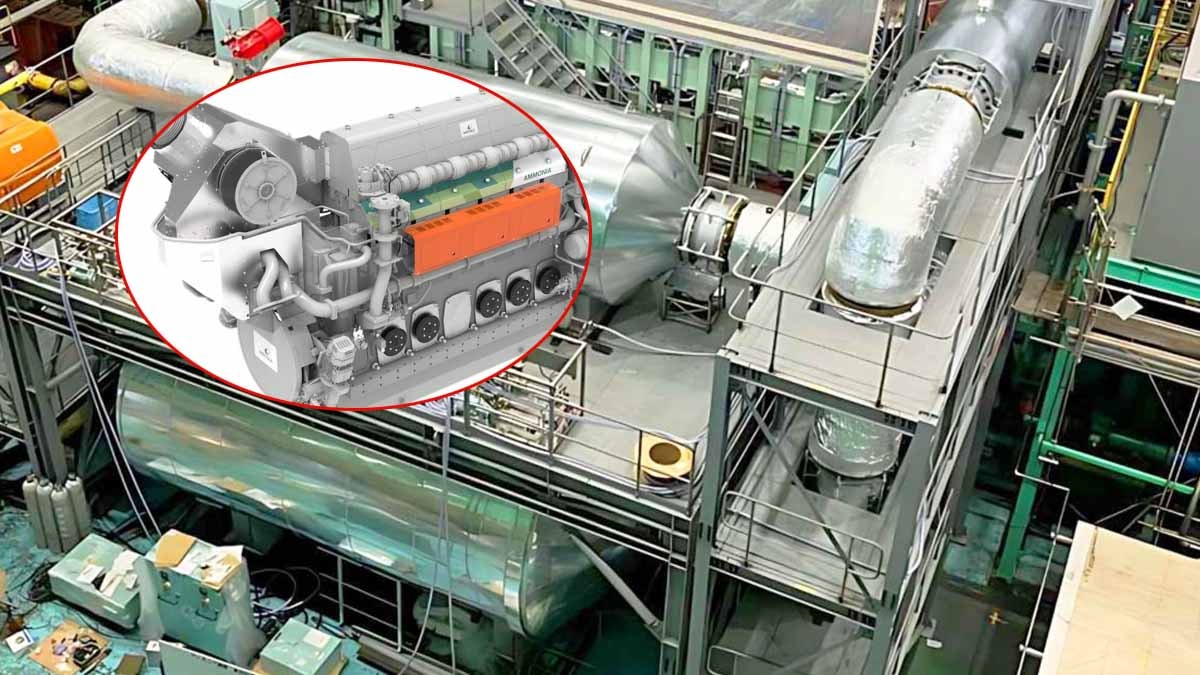
The shipping industry just got a major shakeup. Forget waiting around for hydrogen to save the day; a Japanese company has unveiled the first commercially viable ammonia-fueled marine engine, and it's slated to hit the open seas in 2026. This could be a game-changer, potentially leapfrogging hydrogen in the race to ditch diesel and clean up maritime transport.
Diesel's Demise?! New Fuel Set to EXPLODE in 2026!
Japan Engine Corporation (J-ENG) deserves a huge pat on the back. They've managed to develop an engine powered entirely by ammonia, and it's not just some lab experiment. This thing has been certified by ClassNK, a respected Japanese organization that basically ensures ships are safe and environmentally sound. That certification means it's ready for real-world use.
What makes this particularly exciting is the potential economic impact. The shipping industry is notoriously cost-conscious, and frankly, a lot of these green alternatives are still too expensive to be widely adopted. However, some analyses suggest ammonia could actually become more competitive than hydrogen in the long run. We're talking about a potential scenario where the total cost of ownership for an ammonia engine might only be about 19% higher than traditional fuel – a price worth paying for zero emissions, right?
Of course, there are some caveats. A consultancy called CE Delft threw a bit of cold water on the party, suggesting that the total cost of ownership for ammonia-powered ships could be significantly higher (3 to 3.5 times!) than conventional fuels between 2030 and 2050. That's a pretty big difference. But then again, Argonne National Laboratory pointed out that hydrogen's high price and low energy density could more than double the costs for container ships compared to diesel. It's all about playing the long game and seeing how these technologies mature and their costs come down.
One of the big advantages of ammonia is that we already have a lot of the infrastructure in place to handle it. CE Delft highlights this as a crucial advantage, especially in the medium term. And GreenCarCongress even suggests that "blue ammonia" (ammonia produced with carbon capture) could become the most competitive maritime fuel, even beating out LNG by 2037. That's a pretty bold claim!
The International Maritime Organization (IMO) is pushing the industry hard to adopt zero-emission technologies, setting targets of 5% (potentially up to 10%) by 2030 and complete carbon neutrality by 2050. This is putting pressure on ship owners to invest in cleaner technologies, but ammonia still faces some hurdles. Refueling is currently more expensive than with traditional fuels, and its toxicity requires careful handling. The industry is also only experimenting with ammonia, with just 25 ammonia-fueled dual-fuel vessels on order. Nevertheless, this new engine could just be the spark that the industry needs to start taking ammonia seriously.
Comments
Please sign in with Google to post a comment
No comments yet. Be the first to comment!